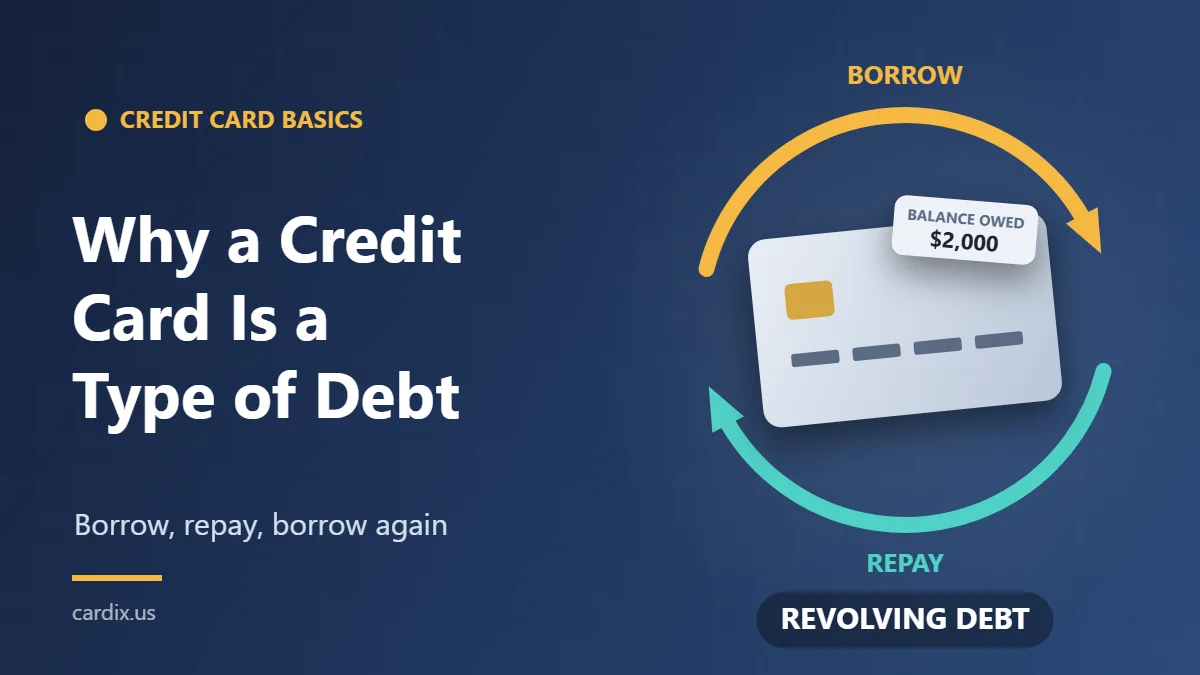
A credit card is a type of debt because every purchase you make with it is money borrowed from the card issuer. The bank pays the merchant right away, and you owe the bank that amount until you repay it. More specifically, a credit card is revolving, unsecured debt: you can borrow, repay, and borrow again up to a limit, and nothing you own is pledged as collateral.
Below: how that differs from a car loan, why carried balances get expensive, and whether it counts as debt if you pay in full.
The Short Answer: Every Swipe Is a Small Loan
When you tap or swipe a credit card, your own money doesn’t leave your bank account. The issuer pays the store, and the amount is added to your balance. Your cardholder agreement makes that balance a legal obligation to repay.
So the debt exists the moment the purchase posts, not only when you fall behind. Paying on time doesn’t mean you never had debt. It means you repaid it before it cost you interest. That’s the key difference from a debit card, which spends money you already have.
Why Credit Cards Are Called Revolving Debt
Debt usually comes in two structures, and credit cards are the most common example of the first:
- Revolving debt gives you a credit limit you can use again and again. As you pay the balance down, that room opens back up. There’s no fixed payoff date, and your payment changes with your balance.
- Installment debt gives you a set amount once, repaid in fixed payments over a fixed term. When it’s paid off, the account closes. Auto loans, mortgages, student loans, and most personal loans work this way.
| Feature | Credit card (revolving) | Car loan (installment) |
|---|---|---|
| How you get money | Borrow as you spend, up to a limit | One lump sum up front |
| Monthly payment | Varies with your balance | Fixed amount |
| End date | None while the account is open | Fixed term, then it closes |
| Collateral | Usually none | The car |
| Interest | Usually avoidable if paid in full | Charged on the loan balance |
The Federal Reserve put U.S. revolving credit at about $1.37 trillion in September 2026, most of it on credit cards.
Why Credit Card Debt Is Unsecured
Secured debt is backed by something the lender can take if you don’t pay, like a house for a mortgage. A standard credit card has no collateral; approval rests mainly on your credit history and income.
Unsecured doesn’t mean “no consequences.” If you stop paying, the issuer can charge late fees, report missed payments to the credit bureaus, send the account to collections, or sue. A court judgment may allow wage garnishment or a bank levy, depending on your state’s laws.
A secured credit card is the exception. It requires a cash deposit that usually sets your limit, but you still owe what you charge.
How Interest Turns a Balance Into Costly Debt
Because unsecured lending is riskier, card rates run high. The Federal Reserve reports the average rate on card accounts charged interest was about 22.4% APR in the third quarter of 2026.
Most cards offer a grace period between the statement date and the due date. As the CFPB explains, if you don’t pay the full balance by the due date, you’re charged interest on the unpaid part, and new purchases usually start accruing interest right away.
A rough example: a $2,000 balance at 22% APR costs about $37 in interest for one month ($2,000 × 22% ÷ 12). Issuers calculate interest daily, so your figure may differ slightly. For more on that line of your bill, see our guide to the purchase interest charge on a credit card.
Minimum payments stretch the debt out. Your statement must show how long payoff takes with minimum payments only, plus the monthly amount that clears the balance in three years. The CFPB notes this 36-month estimate ignores new purchases.
Is It Still Debt If You Pay in Full Every Month?
Technically, yes. You owe the balance from the moment you buy until you pay. In practice, though, paying the full statement balance by the due date typically means no interest on purchases, so the card works like a short, free loan. “Credit card debt” usually means a balance that rolls over and collects interest.
How Card Debt Shows Up on Your Credit
Scoring models look closely at how much of your revolving limit you use, called credit utilization. FICO says “amounts owed” makes up about 30% of a FICO Score, with utilization on revolving accounts a key part. Payment history counts even more, at 35%.
To find your utilization, divide your balance by your limit. A $1,500 balance on a $5,000 limit is 30%. Lower is generally better. Even if you pay in full, the reported balance (often your statement balance) can appear on your credit report that month.
Practical Steps to Keep Card Debt Under Control
- Pay the full statement balance by the due date whenever you can, so the grace period works for you.
- Set autopay for at least the minimum so a busy month never becomes a late payment.
- Know your APR. It’s printed on your statement.
- Watch utilization. Paying part of the balance before the statement closes can lower what gets reported.
- Skip cash advances. They usually carry a fee and start charging interest immediately.
- Make a payoff plan for existing balances: target the highest APR first, or compare 0% intro offers in our list of best balance transfer credit cards if you qualify.
Frequently Asked Questions
Is a credit card a loan?
Broadly, yes. It’s an open-ended line of credit rather than a one-time loan. You borrow only what you spend and can borrow again as you repay.
Is a credit card balance an asset or a liability?
For you, the balance is a liability because it’s money you owe. Your unused limit isn’t an asset, just borrowing room. For how banks classify the account itself, see what type of account a credit card is.
Can credit card debt affect my home?
Not directly, since standard card debt is unsecured, but a court judgment can lead to collection steps. Learn more in can credit card debt take your house.
This article is general educational information, not personal financial or legal advice.

Emma Rose is a U.S.-based personal finance writer and a regular contributor at Cardix.us. She focuses on topics like credit cards, credit scores, and everyday money management. Emma’s writing makes complex financial concepts simple and practical, helping readers make smarter credit and spending decisions with confidence.