
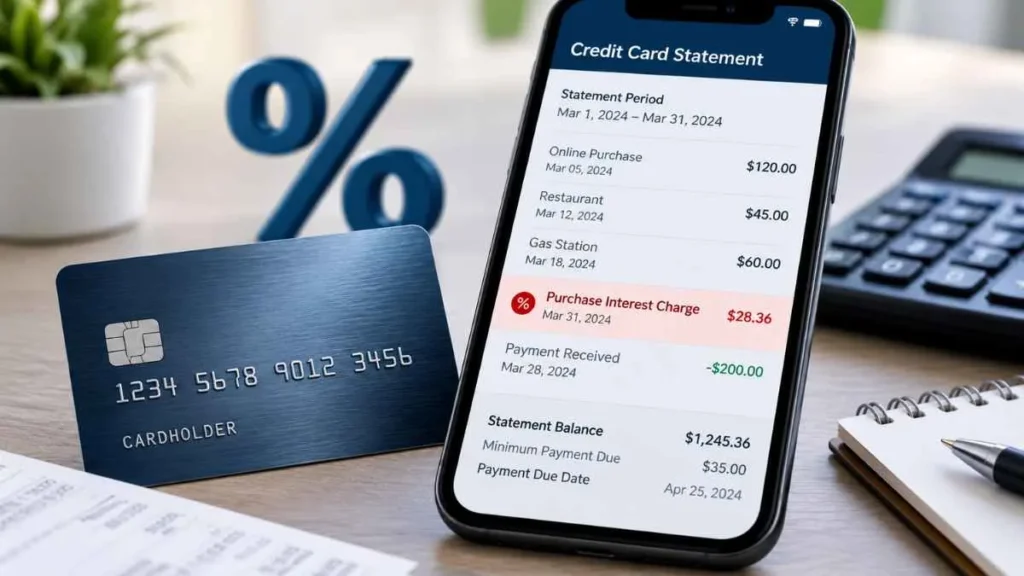
Seeing a purchase interest charge on credit card statement can be confusing. It may look like another purchase, but it is actually interest charged by your credit card issuer. This usually happens when a purchase balance is carried instead of being paid in full under the card’s grace-period terms. Understanding your purchase APR, statement balance, payment due date, and grace period can help you understand the charge and avoid unnecessary interest.
What Is a Purchase Interest Charge on a Credit Card?
A purchase interest charge is interest or a finance charge applied by your credit card issuer when interest accrues on an eligible purchase balance. It is not a second purchase and usually does not come from the merchant.
For example, your statement could show:
PURCHASE — $500
PURCHASE INTEREST CHARGE — $28
The $500 is the actual amount you spent. The $28 is the interest charged for carrying an interest-bearing balance. Your card’s terms determine when and how that interest applies.
Why Am I Being Charged Purchase Interest?
The most common reasons include:
You Carried a Balance
If you do not pay the applicable statement balance in full by the due date, the unpaid purchase balance may accrue interest according to your card’s purchase APR and calculation method.
You Paid Only the Minimum
Making the minimum payment can keep your account current, but it does not necessarily prevent interest. For example, paying $50 toward a $1,000 balance can leave the remaining balance subject to interest.
You Lost Your Grace Period
Many credit cards offer a grace period for purchases. If you carry a balance and lose the grace period, new purchases may also begin accruing interest from their transaction dates, depending on your card’s terms.
You Recently Paid Off the Card
A charge that appears after payoff may be trailing or residual interest. This is interest that accrued before your payment was received or credited.
How Does Credit Card Purchase Interest Work?
The process is easier to understand as:
Purchase → Billing Cycle → Statement → Due Date → Payment → Balance Carried → Interest
Your billing cycle records transactions during a specific period. At the end, the statement closing date determines the statement balance.
The payment due date is when at least the required minimum payment must be made. If your card provides a purchase grace period, paying the applicable statement balance in full by the due date can generally help you avoid purchase interest.
Your payment posting date can also matter because interest calculations may depend on when payments are credited to your account.
How Is Purchase Interest Calculated?
Your purchase APR is the annualized interest rate that applies to eligible purchase balances. Credit cards can have different APRs for purchases, balance transfers, and cash advances.
Many issuers calculate interest using a daily periodic rate and daily balances, although the exact method varies by card agreement.
For a simple example, suppose you have:
- Balance: $2,000
- APR: 24%
- Period: 30 days
Using a simplified 365-day calculation:
$2,000 × 24% ÷ 365 × 30 = $39.45
So the estimated interest would be about $39.45 if the balance stayed unchanged. Your actual charge can differ because your issuer may use a different calculation method and your daily balance may change.
Why Is My Purchase Interest Charge So High?
A large interest charge can result from:
- A high purchase APR
- A large outstanding balance
- Carrying the balance for longer
- New purchases after losing the grace period
- A promotional APR ending
- Multiple balance types
- Residual interest
For example, a $10,000 balance at 30% APR produces roughly $246.58 over 30 days using a simplified 365-day calculation.
The interest is based on the applicable balance and interest terms—not a percentage of your minimum payment.
Why Did I Get Interest Even Though I Paid on Time?
Paying on time does not always mean paying enough to avoid interest.
Suppose your statement balance is $4,000, your minimum payment is $100, and you pay $100 by the due date. Your account may remain current, but the unpaid balance can still accrue interest if you did not meet your card’s grace-period requirements.
Can New Purchases Be Charged Interest?
Yes. If your grace period is active and you meet its requirements, qualifying purchases can generally avoid interest.
If you have lost your grace period, however, new purchases may begin accruing interest from their transaction dates, depending on the card’s terms.
This is why continuing to use a card while carrying an interest-bearing balance can make debt more expensive.
Purchase Interest vs. Other Credit Card Charges
| Charge | Meaning |
|---|---|
| Purchase Interest | Interest on an interest-bearing purchase balance |
| Late Payment Fee | Fee that may apply to a late payment |
| Annual Fee | Fee for maintaining certain cards |
| Cash Advance Interest | Interest on cash advances |
| Balance Transfer Interest | Interest on transferred balances |
| Foreign Transaction Fee | Fee that may apply to certain foreign transactions |
| Purchase Transaction | Actual merchant purchase |
How to Avoid Purchase Interest
To reduce or avoid purchase interest:
- Pay the applicable statement balance in full by the due date.
- Know your purchase APR.
- Understand your grace-period rules.
- Do not rely only on the minimum payment.
- Track promotional APR expiration dates.
- Understand deferred-interest offers.
- Review your statement every month.
- Check for residual interest after paying off a revolving balance.
What If You Don’t Recognize the Charge?
Check your previous statement balance, payment amount and date, purchase APR, grace-period status, promotional balances, and other balance types.
If the charge still does not make sense, contact your card issuer and ask how the interest was calculated. If you believe there is a billing error, follow the issuer’s formal dispute process.
Frequently Asked Questions
What does purchase interest charge mean?
It is interest charged by your credit card issuer when interest accrues on a purchase balance.
Does purchase interest affect my credit score?
The interest charge itself is generally not a separate negative credit-reporting event. However, carrying a balance can affect credit utilization.
Is purchase interest the same as a late fee?
No. Purchase interest is an interest charge, while a late fee is a separate fee that may apply when a required payment is late.
Can purchase interest be removed?
It is not automatically refundable. If you believe the calculation is wrong, ask the issuer to review the charge. A courtesy adjustment may be possible in some cases, but it is not guaranteed.
Bottom Line
A purchase interest charge on credit card statements is generally interest charged by the card issuer on an interest-bearing purchase balance. The most common reason is carrying a balance instead of paying the applicable statement balance in full under the card’s grace-period terms.
If you want to understand a specific charge, check your purchase APR, statement balance, payment date, grace-period rules, and card agreement. These details can explain why the interest appeared and help you avoid similar charges in the future.
Read Also:-1955 Broadway Oakland California Charge on Credit Card

Emma Rose is a U.S.-based personal finance writer and a regular contributor at Cardix.us. She focuses on topics like credit cards, credit scores, and everyday money management. Emma’s writing makes complex financial concepts simple and practical, helping readers make smarter credit and spending decisions with confidence.