
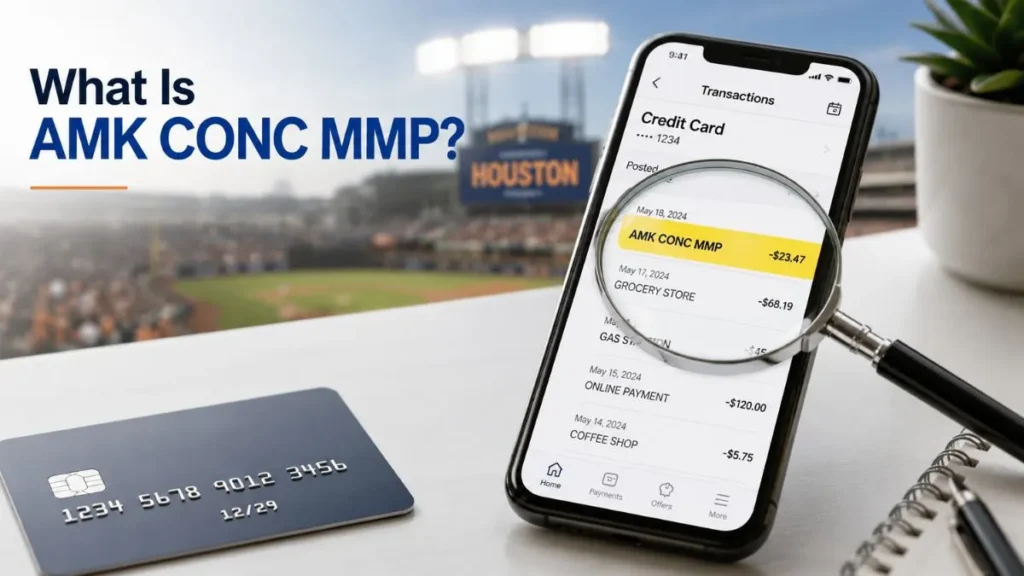
Have you noticed an AMK CONC MMP credit card charge on your statement and wondered where it came from? You’re not alone. Many cardholders become concerned when unfamiliar merchant descriptors appear instead of recognizable business names.
In most reported cases, AMK CONC MMP is associated with purchases made at stadium concession stands, including food, drinks, snacks, or merchandise purchased during sporting events and concerts. This guide explains what the charge means, why it appears, and what to do if you don’t recognize it.
What Is the AMK CONC MMP Credit Card Charge?
The AMK CONC MMP credit card charge is a transaction descriptor used by payment processing systems. Rather than displaying the full merchant name, some transactions appear under abbreviated billing codes.
The descriptor is commonly interpreted as:
- AMK – Payment or concession processing identifier
- CONC – Concessions (food, beverages, and merchandise)
- MMP – Often associated with Minute Maid Park in Houston, Texas
While banks do not always disclose the exact meaning of merchant codes, consumer reports frequently link this descriptor to purchases made inside stadium concession systems.
Where Does the Charge Come From?
Many cardholders report seeing this charge after visiting Minute Maid Park, home of the Houston Astros.
Common purchases that may trigger the charge include:
- Food and beverages
- Popcorn, snacks, and concession items
- Team merchandise and souvenirs
- Mobile-order and self-service kiosk purchases
Because multiple vendors operate inside large venues, transactions are often processed through a centralized payment system rather than individual store names.
Why You May Not Recognize the Charge
There are several reasons why the charge may look unfamiliar.
Merchant Descriptors Can Be Confusing
Credit card statements often display shortened merchant names. Instead of showing the exact concession stand or vendor, the payment processor may use a coded descriptor such as AMK CONC MMP.
Delayed Transaction Posting
A purchase made during an event may not appear immediately. In some cases, transactions post several days after the purchase date, making them harder to remember.
Authorized User Purchases
If you share your card with a spouse, family member, or authorized user, they may have made the purchase without your knowledge.
How to Verify Whether the Charge Is Legitimate
Before assuming fraud, perform a few simple checks:
Review the Transaction Date
Compare the transaction date with:
- Recent travel
- Baseball games
- Concerts
- Stadium visits
- Family activities
Check the Amount
Look through:
- Email receipts
- Mobile wallet history
- Banking app transactions
- Event-related purchases
The amount often helps identify the transaction.
Consider Recent Event Attendance
If you attended a game, concert, or other stadium event, concession purchases may appear under this descriptor rather than the venue name.
What If You Never Visited Minute Maid Park?
If you don’t remember attending an event, there may still be a legitimate explanation.
Possible Reasons
- An authorized user made the purchase
- Your card was stored in a mobile wallet
- The transaction was delayed
- You forgot about a small event-related purchase
When to Suspect Fraud
The charge deserves closer attention if:
- You have never visited the area
- No authorized user could have made the purchase
- Multiple unfamiliar charges appear
- Small test transactions are followed by larger purchases
In these situations, contact your card issuer immediately.
How to Dispute an Unrecognized AMK CONC MMP Charge
If you cannot identify the transaction:
Contact Your Credit Card Issuer
Provide:
- Transaction date
- Transaction amount
- Merchant descriptor
- Last four digits of your card
Request a Merchant Investigation
Banks can access additional merchant information that does not appear on customer statements and may be able to identify the exact business behind the charge.
Freeze or Lock Your Card
If fraud is suspected, temporarily lock your card through your banking app until the investigation is complete.
Monitor Your Account
Enable transaction alerts and watch for any additional unauthorized activity.
Tips to Prevent Future Credit Card Confusion
To avoid uncertainty with future charges:
- Enable real-time purchase notifications
- Save digital receipts and confirmation emails
- Review credit card statements every month
- Use merchant lookup tools when unfamiliar descriptors appear
These habits make it easier to identify legitimate purchases and spot fraud early.
Frequently Asked Questions
Is AMK CONC MMP a scam?
Not usually. Most reports connect the charge to stadium concession purchases. However, any unrecognized transaction should be verified.
Can a stadium purchase appear under a different name?
Yes. Payment processors often use abbreviated merchant descriptors instead of the venue’s public name.
Why doesn’t my statement show Minute Maid Park directly?
Large venues commonly process transactions through centralized concession systems, which may display coded billing names.
How long after a purchase can the charge appear?
Depending on the merchant and payment processor, charges may appear immediately or several days later.
Should I dispute the charge if I don’t recognize it?
Yes. If you cannot identify the purchase after reviewing your records, contact your credit card issuer and request an investigation.
Conclusion
The AMK CONC MMP credit card charge is commonly associated with concession purchases made at stadium events, particularly those reported by consumers after visits to Minute Maid Park. In many cases, the charge is legitimate and represents food, beverage, or merchandise purchases processed through a concession payment system.
However, if the transaction remains unfamiliar after reviewing your receipts, event history, and authorized users, contact your bank immediately. Taking prompt action can help protect your account and quickly resolve any unauthorized activity.
Read Also:-UACOM MD Charge on Credit Card

Emma Rose is a U.S.-based personal finance writer and a regular contributor at Cardix.us. She focuses on topics like credit cards, credit scores, and everyday money management. Emma’s writing makes complex financial concepts simple and practical, helping readers make smarter credit and spending decisions with confidence.