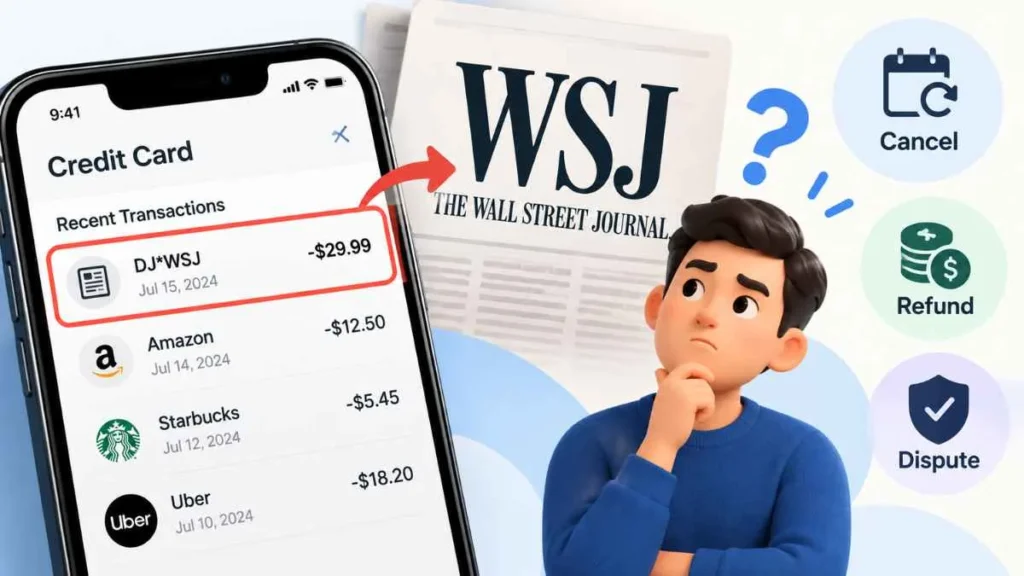
Seeing a dj wsj charge on credit card can be confusing, especially when you do not remember making a payment to The Wall Street Journal. In most cases, DJ*WSJ is a billing descriptor associated with The Wall Street Journal and its publisher, Dow Jones & Company. The charge may relate to a subscription, renewal, or another WSJ payment. However, the descriptor alone cannot confirm the exact reason. This guide explains why the charge appears, how to identify it, cancel it, request refunds, and dispute unauthorized transactions.
What Is a DJ WSJ Charge on a Credit Card?
A DJ*WSJ charge generally refers to a payment associated with The Wall Street Journal (WSJ) and Dow Jones & Company.
In simple terms:
- DJ = Dow Jones
- WSJ = The Wall Street Journal
The Wall Street Journal is published by Dow Jones & Company. Therefore, seeing a DJ*WSJ descriptor on your credit-card statement generally points to WSJ or related Dow Jones billing.
Importantly, this is not a charge for the Dow Jones stock-market index. The Dow Jones Industrial Average is a stock-market index, while Dow Jones & Company is the media company associated with WSJ.
The exact wording can vary between credit-card issuers and payment processors. A merchant descriptor may be shortened, abbreviated, or formatted differently from the company’s familiar name.
What Other Names Can the Charge Appear Under?
A WSJ-related payment may appear under descriptors such as:
- DJ*WSJ
- D J*WALL-ST-JOURNAL
- D J*WALL ST JOURNAL
- WSJ DIGITAL
- D J*WALL ST JRNL IPAD
Other closely related Dow Jones or WSJ descriptors may also appear.
Different wording does not necessarily mean a different company. Always consider the full descriptor, transaction date, amount, and other statement details together.
Why Did I Get a DJ WSJ Charge?
There are several legitimate reasons you might see this charge.
You Have an Active WSJ Subscription
You may have an active WSJ digital, print, or applicable bundled subscription. If recurring billing is enabled, the saved payment method can be charged automatically according to your subscription terms.
Your WSJ Subscription Renewed
The payment may be an automatic subscription renewal. This can happen even if you originally subscribed months ago and rarely use the account.
If the amount changed, compare the charge with your current subscription and renewal terms.
A Promotional Rate Ended
You may have initially received an introductory price. After the promotional period ends, the applicable renewal pricing may take effect.
Check your original offer, confirmation email, and renewal terms rather than relying on amounts reported by other customers online.
Someone Else Used Your Card
A spouse, family member, authorized card user, or employee may have used the card to purchase or renew WSJ access.
Check with anyone who has permission to use the payment method.
The Subscription Uses a Different Email Address
You may not immediately find the subscription if it was created with an older personal email, work email, or another address.
Search your other inboxes for WSJ, Wall Street Journal, Dow Jones, subscription, renewal, or receipt.
You Paid Through PayPal
If you previously used PayPal, the charge may be connected to a PayPal automatic-payment agreement.
Check your PayPal account for automatic payments associated with WSJ or a related merchant. Remember that stopping a PayPal automatic payment may not cancel the underlying merchant subscription.
The Charge May Be Unauthorized
If you never subscribed, nobody authorized the payment, and you cannot connect the transaction to any account or payment method, investigate it promptly.
Contact WSJ first for transaction details. If the charge remains unexplained or unauthorized, contact your credit-card issuer.
Is DJ WSJ a Legitimate Charge?
Yes, a DJ*WSJ charge can be a legitimate WSJ or Dow Jones payment. However, the descriptor itself does not prove that a particular transaction was authorized.
If you recognize the subscription and billing information, the charge is likely legitimate. If you do not recognize it, investigate the transaction before assuming it is fraud.
Why You Shouldn’t Assume It Is a Scam
An unfamiliar descriptor does not automatically indicate fraud. Merchant names can be shortened or displayed differently by payment processors.
Recurring subscriptions can also renew automatically, and payments made through different billing channels may use different descriptors.
When Should You Treat the Charge as Suspicious?
Investigate the charge more closely if:
- You never subscribed to WSJ.
- Nobody authorized the payment.
- You cannot find any related account or payment agreement.
- WSJ cannot identify the transaction.
- The charge continues after confirmed cancellation.
How to Find Out What the DJ WSJ Charge Is For
Use this checklist to identify the payment:
Check the Charge Details
Record the amount, date, exact descriptor, phone number if displayed, and whether the transaction is recurring or one-time.
Check Your WSJ Account
Review your subscription status, billing history, payment method, and renewal information.
Search Your Email
Search for:
- “WSJ”
- “Wall Street Journal”
- “Dow Jones”
- “subscription”
- “renewal”
- “receipt”
Check PayPal
Review your PayPal automatic payments if you have previously used PayPal for subscriptions.
Ask Household or Authorized Card Users
Confirm whether someone else with access to your card subscribed to or renewed WSJ.
How to Cancel a DJ WSJ Charge
You do not cancel the DJ*WSJ statement descriptor. You cancel the underlying WSJ subscription or payment agreement creating the charge.
Cancel Through WSJ
Use the official WSJ Customer Center to review your subscription and follow its cancellation process.
Have your account email and billing information available if needed. Cancellation and refunds are separate matters, so review WSJ’s applicable cancellation and refund policy.
Cancel a PayPal Automatic Payment
If PayPal is handling the recurring payment, review the automatic-payment agreement in your PayPal account.
Stopping the PayPal payment may prevent future PayPal charges, but it may not cancel the underlying WSJ subscription. Contact WSJ separately when necessary.
Can You Get a Refund for a DJ WSJ Charge?
A refund may be available, but eligibility depends on the applicable WSJ terms, cancellation and refund policy, and circumstances of the transaction.
Do not assume that cancellation automatically guarantees a refund.
What to Have Ready When Requesting a Refund
Keep these details available:
- Charge date
- Amount
- Account email
- Cancellation date
- Confirmation email
- Confirmation number
- Last four digits of the payment method, if requested
What If You Never Authorized the DJ WSJ Charge?
If you cannot connect the payment to a WSJ account or authorized user, take action promptly.
Contact WSJ First
Ask WSJ to identify the subscription or transaction using the charge date, amount, and information they request.
Contact Your Credit Card Issuer
If the transaction remains unexplained or unauthorized, contact your card issuer using the number on your card.
For applicable U.S. credit-card billing errors, federal rules generally provide a 60-day written-notice period from the statement date for certain billing-error protections. Follow your issuer’s dispute instructions.
Keep Documentation
Save your statements, emails, screenshots, cancellation confirmations, receipts, and customer-support conversations.
What If I Was Charged After Canceling WSJ?
Compare the cancellation date with the charge date and keep your cancellation confirmation.
If the payment occurred after confirmed cancellation, contact WSJ with your proof. If the issue remains unresolved, ask your credit-card issuer about its dispute process.
Why Did the Charge Amount Change?
The amount may change because of:
- Promotional pricing ending
- Applicable renewal pricing
- A different subscription plan
- Different billing frequency
- Applicable taxes or other charges
Do not treat random amounts found on forums as official WSJ pricing. Your subscription terms and billing records are more reliable.
DJ WSJ vs. Other Dow Jones Charges
Not every DJ descriptor necessarily represents the exact same product. Dow Jones is associated with publications and services such as The Wall Street Journal, Barron’s, and MarketWatch.
Because billing descriptors can vary, check the complete descriptor, amount, date, and transaction details when identifying a charge.
Frequently Asked Questions
What does DJ WSJ mean on a credit card?
DJ*WSJ generally refers to billing associated with The Wall Street Journal and its publisher, Dow Jones & Company.
Is DJ WSJ a Wall Street Journal charge?
Yes, DJ*WSJ is generally associated with WSJ or Dow Jones-related billing, including subscriptions and renewals.
Why is DJ WSJ charging me every month?
A monthly DJ*WSJ charge usually indicates recurring subscription billing associated with an active WSJ service.
Why did my DJ WSJ charge increase?
The amount may increase when promotional pricing ends or different renewal, plan, or billing terms apply.
Is DJ WSJ a scam?
Not necessarily; DJ*WSJ can represent legitimate WSJ billing, but unfamiliar transactions should always be investigated.
How do I cancel DJ WSJ?
Cancel the underlying WSJ subscription through WSJ rather than attempting to cancel the statement descriptor itself.
Can I get a refund from WSJ?
Refund eligibility depends on WSJ’s applicable cancellation and refund policy and your specific transaction circumstances.
What if I don’t have a WSJ account?
Check other email addresses, household users, PayPal automatic payments, and contact WSJ or your card issuer if needed.
Can I dispute a DJ WSJ charge?
Yes, contact your card issuer promptly if you believe the charge is unauthorized or represents a billing error.
Conclusion
A DJ*WSJ charge generally points to billing associated with The Wall Street Journal or Dow Jones. It is commonly connected with a subscription, renewal, or related payment.
However, the charge is not automatically a scam. First check your WSJ account, email receipts, PayPal automatic payments, and household or authorized users.
If you still cannot explain the transaction or believe it was unauthorized, contact WSJ and your credit-card issuer promptly and keep documentation of your communications.
Read Also:-CFX VES WEBSITE Charge on Credit Card

Emma Rose is a U.S.-based personal finance writer and a regular contributor at Cardix.us. She focuses on topics like credit cards, credit scores, and everyday money management. Emma’s writing makes complex financial concepts simple and practical, helping readers make smarter credit and spending decisions with confidence.