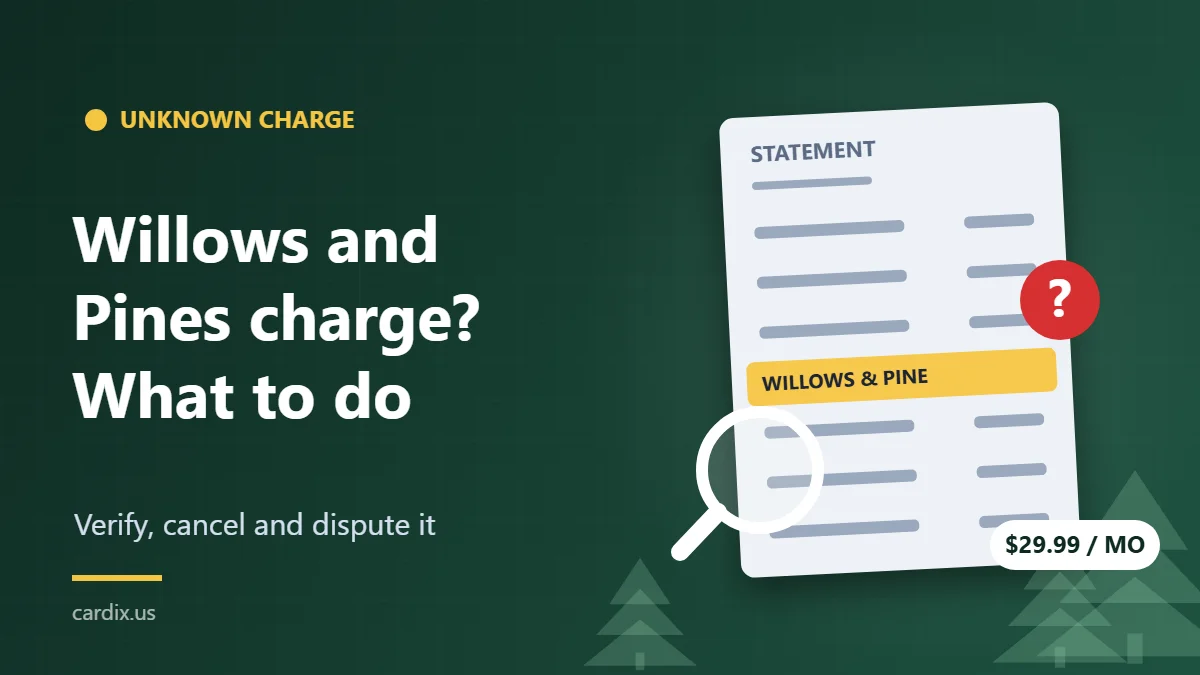
If a Willows and Pines credit card charge showed up on your statement, it may be tied to a beauty shop’s paid membership, but nobody has confirmed that publicly. One charge-lookup site lists “Willows & Pine” as a billing name for Essence and Honey, an online beauty store that sold a $29.99 “VIP Membership Club.” We couldn’t confirm that link with the merchant, a business registry, or a bank. The store’s website has also gone offline, which changes how you get your money back. Here’s what’s known and how to stop it.
What the Willows and Pines charge is linked to
“Willows and Pines” (sometimes shown as “Willows & Pine”) is a merchant descriptor. That’s the short name a business uses on card statements, and it often doesn’t match the store’s website.
Here is what we found, sorted by how solid it is:
| Claim | Status |
|---|---|
| The descriptor is linked to Essence and Honey’s VIP club | Reported by one charge-lookup site (April 2026). Not confirmed by the merchant. |
| Essence and Honey ran a “VIP Membership Club” with an online cancellation form | Confirmed on an archived copy of the store’s own site (June 2025). |
| The VIP fee is $29.99 plus tax every 30 days, starting 12 days after sign-up | Reported by the same lookup site. We couldn’t find the merchant’s own terms. |
| Essence and Honey’s website is still active | No. In November 2026, essenceandhoney.com showed a GoDaddy page saying the domain had expired. |
The same lookup site also names “Honey and Pine” and “TryHiveHoney” as related names. Treat those as leads, not facts.
Is it part of the “tree-name” charge network?
Possibly, but there’s no proof. Willows and Pines sounds a lot like Timber and Oaks, Aspen and Oaks, Ash and Hollows, and Brooks and Cedar. BBB Scam Tracker reports describe surprise $29.99 charges under those names after small online orders.
However, in the Scam Tracker reports we reviewed, no one named Willows and Pines. The only public source for this descriptor ties it to a beauty store, not the clothing shops in those reports. Similar names don’t prove common ownership. If you want to compare, see our guide to the Timber and Oaks charge.
Why you might be seeing it
These are possibilities, not confirmed explanations:
- A membership was added to a purchase. If you bought skincare, hair tools, or makeup brushes online, a VIP or “special offer” upgrade may have been added at checkout. The FTC warns shoppers to watch for pre-checked boxes and save proof when you cancel.
- Your card was misused. If you haven’t bought anything similar, treat the charge as unauthorized.
How to tell whether it’s yours
- Search your email for “Essence and Honey,” “VIP,” “membership,” “Willows,” and “$29.99,” including spam folders.
- Check the timing. A first charge about two weeks after an online order, followed by repeat charges about 30 days apart, fits the reported VIP pattern.
- Open the transaction details in your card app. Many issuers show a phone number, website, or city under the short name.
- Write down every charge, with its date and amount. You’ll need this list for a dispute.
How to stop it when the merchant has disappeared
This is where Willows and Pines differs from most charges. The usual advice is to cancel with the merchant first. But Essence and Honey’s cancellation page, which once asked members to fill out a form saying “Cancel My Membership,” now leads to a parked domain. If no cancellation route works, go straight to your card issuer.
Step 1: Try any contact details you have
If your order confirmation lists an email address, send one short message asking to cancel the membership and refund the fees. Save a copy. If it bounces or nobody replies within a few days, move on. A bounced email is useful proof for your dispute.
Step 2: Dispute the charges with your card issuer
Call the number on the back of your card or use the dispute option in your app. Say the charges are for a membership you didn’t knowingly agree to and that the merchant can’t be reached. For billing errors, the FTC says your written dispute must reach the issuer within 60 days after the first bill with the error was sent to you. Use the billing-inquiries address, not the payment address. The issuer must acknowledge your dispute within 30 days and resolve it within 90. You can hold back the disputed amount while it investigates, but you still need to pay the rest of the bill.
Older charges may fall outside that window. Ask your issuer anyway, because some issuers accept later disputes under their own policies.
Step 3: Ask for a new card number
Blocking the merchant may not stop a company that bills under changing names. A replacement card with a new number does.
If you never shopped there
Report the charge as fraud. According to the CFPB, if someone uses your account number while you still have the card, you generally aren’t responsible for those charges. If the charge hit a debit card, call your bank the same day, since debit protections depend on how quickly you report.
You can also file a report at ReportFraud.ftc.gov. It helps regulators track billing that uses rotating names.
Related charges
Other nature-themed descriptors work in a similar way. See our guides to the Aspen and Oaks charge, the Ash and Hollows charge, and the Brooks and Cedar charge.
FAQs
Is Willows and Pines a scam?
We can’t say. We found no registration, official site, or BBB profile under that name, and the business linked to it is no longer online. Treat any charge you didn’t clearly agree to as one you can dispute.
Can I still cancel with Essence and Honey?
Not through its website, which showed an expired-domain page when we checked in November 2026. Your card issuer is the practical route now.
Will I get back every charge?
That depends on your issuer and how old the charges are. Recent ones are the easiest to recover, so act quickly and include your full list of dates and amounts.
This article is general information, not financial or legal advice. Check your cardholder agreement and talk to your card issuer about your situation.

Emma Rose is a U.S.-based personal finance writer and a regular contributor at Cardix.us. She focuses on topics like credit cards, credit scores, and everyday money management. Emma’s writing makes complex financial concepts simple and practical, helping readers make smarter credit and spending decisions with confidence.