
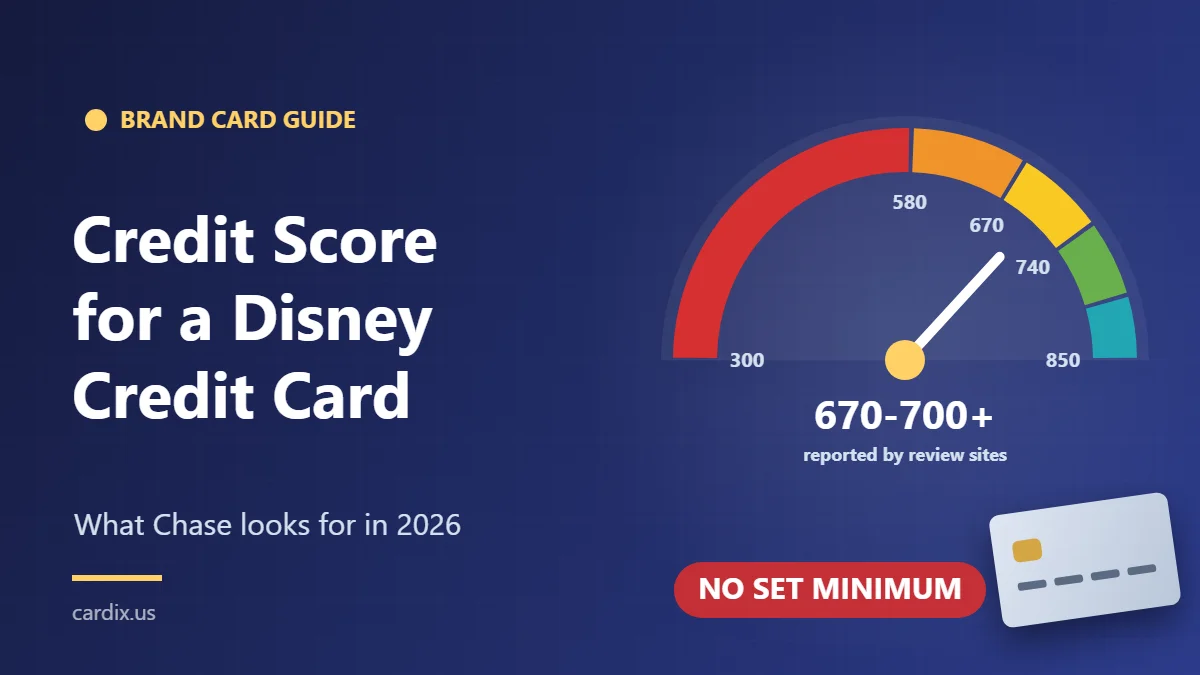
Chase, which issues every Disney credit card, does not publish a minimum credit score. Major card review sites generally suggest a FICO score of about 670 or higher (good credit) for the no-annual-fee Disney Visa and about 700 or higher for the Disney Premier Visa and the newer Disney Inspire Visa. Those numbers are estimates, not rules. Chase looks at your whole credit profile, so a score above them doesn’t guarantee approval, and a score a bit below them doesn’t guarantee a denial.
This guide covers what Chase actually says, what third parties report, and how to check your odds before applying.
Disney credit cards at a glance (as of November 2026)
There are now three Disney Visa cards, all issued by JPMorgan Chase Bank. The fees, rewards and offers below come from the official Disney Visa card comparison page. The score column is not from Chase. It shows what independent review sites report.
| Card | Annual fee | Rewards (Disney Rewards Dollars) | New cardmember offer | Score reported by third parties |
|---|---|---|---|---|
| Disney Visa | $0 | 1% on all purchases | $150 statement credit after $500 in purchases in 3 months | About 670+ (Crediful) |
| Disney Premier Visa | $49 | 5% at DisneyPlus.com, Hulu.com and Stream.ESPN.com; 2% at gas stations, grocery stores, restaurants and most U.S. Disney locations; 1% elsewhere | $300 statement credit after $1,000 in purchases in 3 months | About 700+ (Crediful, WalletHub, CardRatings) |
| Disney Inspire Visa | $149 | 10% at DisneyPlus.com, Hulu.com and Stream.ESPN.com; 3% at gas stations and most U.S. Disney locations; 2% at grocery stores and restaurants; 1% elsewhere | $500 statement credit after $1,000 in purchases in 3 months | About 700+ (Crediful) |
WalletHub lists 700 or better even for the no-fee Disney Visa, while Crediful puts it closer to 670. No one outside Chase knows the real cutoff, and offers change often.
What Chase officially says about eligibility
The official Disney Visa application FAQ lists only one hard requirement: a valid permanent home address in the 50 states, Washington, D.C., Guam, Puerto Rico or the U.S. Virgin Islands, or a U.S. military address. Beyond that, accounts are “subject to credit approval.”
The same FAQ says some applicants get an instant decision, while others get their answer by mail. Approved cards usually arrive within 7 to 10 business days.
What Chase weighs besides your score
Your score is a summary of your credit report, and Chase reviews the report itself. FICO describes a good score as 670 to 739, and it bases scores on five factors:
- Payment history (35%): Recent late payments hurt most.
- Amounts owed (30%): High balances compared with your limits lower your odds.
- Length of credit history (15%): A thin or new file can mean a denial.
- New credit (10%): Many recent applications signal risk.
- Credit mix (10%): Cards plus loans help a little.
Lenders also look at your income and monthly debt payments, and your history with existing Chase accounts may matter too.
Does the Chase 5/24 rule apply?
Many card sites and forum users describe an unofficial Chase policy known as “5/24”: applicants who opened five or more personal card accounts with any issuer in the past 24 months are often denied. Chase has never published this rule. Forum reports conflict on whether it applies to the Disney cards, so treat it as a possibility. If you’ve opened several cards recently, waiting a few months may be the safer move.
How to improve your odds before you apply
- Pull your credit reports. The FTC explains that you can get free credit reports from all three bureaus at AnnualCreditReport.com. Dispute any errors you find.
- Know your score. Many banking apps show one free. Under about 670, think twice about the Premier or Inspire.
- Pay down balances. It’s one of the fastest ways to raise your score.
- Pause other applications. Each application usually adds a hard inquiry, and new accounts count toward the reported 5/24 limit.
- Check Chase’s pre-approved offers. Chase says that filling out its pre-approved offers form will not affect your credit score. A Disney card may not appear there, and a pre-approved offer is still not a guaranteed approval.
- Start with the right card. If your credit is fair to good, the no-fee Disney Visa is the lower-risk choice. The official upgrade FAQ says Disney Visa cardmembers can call Chase to ask about moving to the Premier or Inspire card later, and their Rewards Dollars carry over.
Which Disney card should you choose?
Pick based on how you spend. The no-fee Disney Visa suits casual fans. The $49 Premier pays off for families who spend regularly on groceries, gas, dining and Disney streaming. The $149 Inspire adds yearly perks such as up to $120 in Disney+, Hulu and ESPN credits and a $100 credit on U.S. Disney theme park tickets, so it mainly suits frequent park visitors.
All three share core perks, including 0% promotional APR for 6 months on select Disney vacation packages (then a variable 18.49% to 27.99% APR) and 10% off select park dining and merchandise.
What if you’re denied or your score is too low?
If Chase denies you, it must tell you the reason or how to request it. Fix that issue before reapplying. Some forum users report approvals after calling Chase’s reconsideration line, but those are individual stories, not a guaranteed path.
If your score is below the fair range, a card built for rebuilding credit is a better first step. See our list of the best credit cards for bad credit in 2026. For park trips, compare the best credit card for family travel. For other store and brand cards, see what score you need for the TJ Maxx credit card or the Lowe’s credit card.
Quick answers
Can I get a Disney credit card with a 650 score?
Possibly, but it’s harder. 650 is below the “good” range most review sites suggest, so the no-fee Disney Visa is your most realistic option.
Does applying hurt my credit?
A full application usually triggers a hard inquiry, which can lower your score slightly for a while. Checking Chase’s pre-approved offers does not.
This article is for general information only and isn’t financial advice. Card terms are as of November 2026 and can change; confirm them with Chase before applying.

Emma Rose is a U.S.-based personal finance writer and a regular contributor at Cardix.us. She focuses on topics like credit cards, credit scores, and everyday money management. Emma’s writing makes complex financial concepts simple and practical, helping readers make smarter credit and spending decisions with confidence.