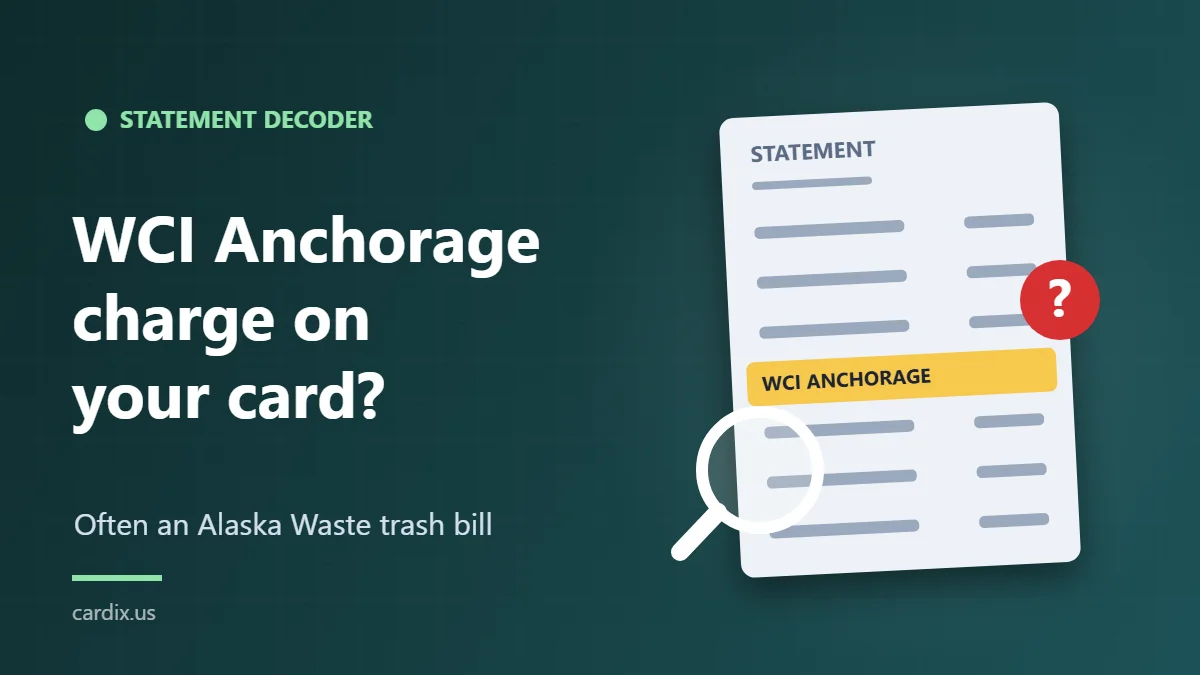
If “WCI Anchorage” showed up on your credit card statement, the most likely source is your trash bill. WCI is the short form of Waste Connections, Inc., the company that owns Alaska Waste, the private garbage and recycling hauler serving much of Anchorage. Alaska Waste’s own customer portal runs on a Waste Connections domain (wcicustomer.com), which is why your card statement can show the parent company’s initials instead of the brand name on your trash cart.
Still, a descriptor alone doesn’t prove who charged you. Below: how to confirm the charge, why it can surprise you, and what to do if you didn’t authorize it.
What “WCI Anchorage” Usually Means
Waste Connections announced in 2011 that it was buying the Anchorage businesses operating as Alaska Waste, which still uses that name. Its website carries the Waste Connections logo, and its account portal is myaccount.wcicustomer.com. So “WCI” plus “Anchorage” points clearly to an Alaska Waste payment.
Its Anchorage location page lists residential curbside trash and recycling, business dumpsters, roll-off containers, septic pumping and portable toilets. Any of these can produce a card charge, so a large one-time amount may be a roll-off rental rather than a regular trash bill.
One caveat: we couldn’t find a published list of the exact descriptor text Waste Connections sends to card networks, and the wording can vary by bank. Treat “WCI Anchorage” as a strong clue, not proof, and confirm it using the steps below.
Anchorage Has Two Trash Providers. Know Which One Bills You
Anchorage doesn’t have a single garbage company.Solid Waste Services (SWS) is a utility owned by the Municipality of Anchorage. It collects trash within its own service area and runs the regional landfill. Alaska Waste is a private company serving other parts of town and the surrounding region.
This matters for two reasons:
- If your home is served by SWS, a WCI charge isn’t your household trash bill. It could be a dumpster, septic or business account, or a charge you need to question.
- If you just moved within Anchorage, you may have switched from one provider’s area to the other’s. An old Alaska Waste account that was never closed can keep billing your card.
Unsure? Ask your landlord or HOA which hauler serves the address.
Why the Charge Can Look Unfamiliar
Legitimate WCI Anchorage charges catch people off guard for a few predictable reasons:
- The name doesn’t match the cart. Your cart says “Alaska Waste”; your statement says “WCI.”
- Billing happens in advance. Alaska Waste’s bill-pay page says residential service is billed in advance, while commercial service is billed monthly. A charge can land before a service period even starts, including right after you sign up.
- Extra pickups come later. The same page says extra refuse is billed on the invoice after the service, so a bill can be higher than usual.
- Autopay is easy to forget. If you set up automatic payments when you moved in, months may pass before you notice the line item again.
- Someone else used your card. A roommate, family member or property manager may have paid a trash account with your card.
How to Verify a WCI Anchorage Charge
Work through these steps in order:
- Check the transaction details in your banking app. Look for a phone number, city or merchant category. A utility or sanitation category supports the Alaska Waste explanation.
- Search your email for “Alaska Waste,” “Waste Connections” or “wcicustomer.” Welcome emails, autopay confirmations and receipts usually show up quickly.
- Log in to MyAccount at myaccount.wcicustomer.com, or create a login with the account number from a paper bill. Compare the charge date and amount with your payment history.
- Call the Anchorage office at 907-563-3717 (toll-free 866-563-3717), the numbers listed on Alaska Waste’s official Anchorage page. Have the charge date and amount ready. They can tell you whether it matches an account without you sharing your full card number.
- Ask anyone who shares the address or manages the property whether they set up service.
Use only contact details from Alaska Waste’s official website or a paper bill.
If It’s Yours: How to Change or Stop the Charges
If the charge checks out, you can manage it yourself:
- Turn off or change autopay in the MyAccount portal, which also shows your statements and payment history.
- Moving out of the area? Alaska Waste has an online “I Am Moving” form for stopping service or transferring it to a new address. Submit it before you move so you aren’t billed for a service period at a home you’ve left.
- Billing question or overcharge? Call the Anchorage office first. Fixing an error with the company is usually faster than a bank dispute.
Don’t dispute a legitimate bill just to stop future charges; the balance can come back as past due. Cancel with the company instead.
If It’s Not Yours: Dispute It and Secure Your Card
If no account is tied to you, your address or anyone you know, treat the charge as unauthorized:
- Call your card issuer using the number on the back of your card. Report the charge and ask them to lock or reissue the card.
- Put your dispute in writing. Under federal billing-error rules, the FTC explains that your letter must reach the issuer within 60 days after the first statement showing the error was sent. Send it to the billing-inquiries address, not the payment address.
- Know your liability limit. The CFPB says your responsibility for unauthorized credit card charges is capped at $50, and it’s generally zero if only your card number, not the physical card, was stolen.
- Review other recent charges for more unfamiliar items.
Quick Answers
Is WCI Anchorage a scam?
The name itself points to a real company, Waste Connections, which operates Alaska Waste. A charge with that name is usually a real trash or roll-off bill, but you should still confirm it matches your account.
Why would I see WCI Anchorage if I don’t live in Alaska?
You may own or manage property there, have paid a bill for a relative, or recently moved away with autopay still on. If none of those apply, contact your issuer.
For other location-style descriptors, see our guides to the ASCEND FS AK charge, the 30 Rockefeller Plaza charge and the Pound Newtown Square PA charge.

Emma Rose is a U.S.-based personal finance writer and a regular contributor at Cardix.us. She focuses on topics like credit cards, credit scores, and everyday money management. Emma’s writing makes complex financial concepts simple and practical, helping readers make smarter credit and spending decisions with confidence.