
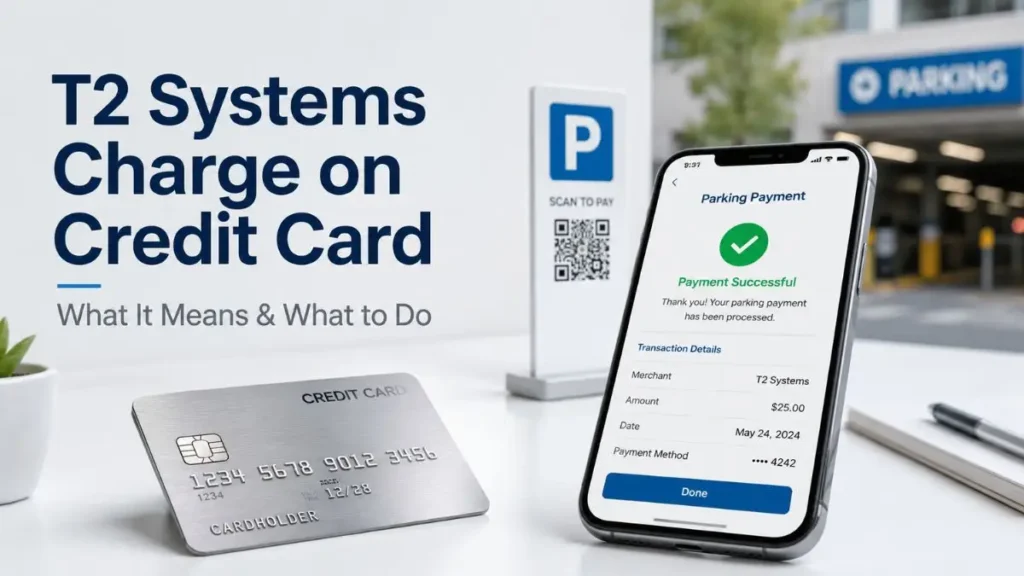
Finding a T2 Systems charge on your credit card can be confusing, especially if you don’t recognize the name. In most cases, it’s a legitimate parking-related payment rather than an unfamiliar purchase. T2 Systems provides parking payment technology used by airports, universities, hospitals, cities, and private parking operators across the United States. This guide explains why the charge appears, when it may be a concern, and the steps to take if you don’t recognize it.
Quick Answer
A T2 Systems charge on a credit card usually means you paid for a parking service through a parking operator that uses T2 Systems’ payment platform. The charge may be for a parking session, permit, or parking citation. If you don’t remember making the payment, review your receipts and recent travel before reporting it as unauthorized.
What Is T2 Systems?
T2 Systems is a U.S. company that develops software and payment solutions for parking management. It doesn’t own parking garages or parking lots. Instead, it provides the technology that allows organizations to accept parking payments, manage permits, and process parking citations.
Because T2 Systems processes payments for many parking operators, its name may appear on your credit card statement instead of the actual parking facility.
Why Does a T2 Systems Charge Appear?
A T2 Systems charge appears because the parking operator uses T2 Systems to process card payments. Even if you parked at an airport, university, hospital, or city parking garage, the merchant name on your statement may display T2 Systems or T2 MobilePay.
For example:
You park at an airport → Pay by QR code or mobile payment → Payment is processed by T2 Systems → Your statement shows “T2 Systems.”
This type of merchant descriptor is common and doesn’t automatically indicate fraud.
Common Reasons for a T2 Systems Charge
Most T2 Systems charges are linked to one of the following:
- Parking session at a public or private parking lot.
- Airport parking for short-term or long-term stays.
- University parking for students, staff, or visitors.
- Hospital parking for patients and guests.
- City or municipal parking in public garages or street parking.
- Parking permit for monthly or annual access.
- Parking citation or parking ticket payment.
- Mobile parking payment made through T2 MobilePay or a QR code.
If you recently used any of these services, the charge is likely legitimate.
Is the Charge Legitimate?
In most cases, yes. T2 Systems is a legitimate parking technology provider trusted by organizations throughout the United States. However, a legitimate merchant can still appear on an unauthorized transaction if your card was used without your permission or a billing error occurred.
Before assuming fraud, compare the transaction with your recent parking activity, travel history, and email receipts. Many people discover the charge is connected to a parking payment they simply didn’t recognize because the parking operator’s name wasn’t shown on the statement.
What to Do If You Don’t Recognize the Charge
If you don’t recognize a T2 Systems charge on your credit card, don’t panic. Follow these steps before reporting it as fraud:
- Review your statement for the transaction date and amount.
- Check your parking receipts and email confirmations.
- Think about recent travel, including airports, hospitals, universities, or city parking.
- Ask family members or authorized card users if they used your card.
- Contact the parking operator to request transaction details.
- Call your card issuer if the charge still can’t be verified.
Taking these steps can help you determine whether the payment is legitimate or unauthorized.
Can the Charge Be Fraudulent?
Yes, it’s possible—but it doesn’t mean T2 Systems is a fraudulent company.
Unauthorized transactions can happen if:
- Your credit card information was compromised.
- Someone else used your card without permission.
- A duplicate payment was processed.
- A billing or merchant error occurred.
If the charge is from a location you’ve never visited or the amount seems incorrect, contact the parking operator first. If they can’t verify the payment, report the transaction to your credit card issuer and request a dispute.
Can You Get a Refund?
Yes, but refunds are usually handled by the parking operator, not T2 Systems.
If you were charged twice, paid the wrong amount, or were billed by mistake, contact the organization that operates the parking facility. This could be an airport, university, hospital, city parking department, or private parking company.
If the issue isn’t resolved or the charge is unauthorized, your credit card issuer can investigate the transaction through the dispute process.
Frequently Asked Questions
Is T2 Systems a scam?
No. T2 Systems is a legitimate parking technology company that processes parking payments for many organizations.
Does T2 Systems own parking garages?
No. It provides payment technology but doesn’t own or operate parking facilities.
Why does my statement show T2 Systems instead of the parking lot?
The payment was processed through T2 Systems, so its name appears as the merchant descriptor.
Is it a subscription?
Usually no. Most charges are one-time parking payments, although recurring parking permits are possible.
Final Thoughts
A T2 Systems charge on your credit card is usually linked to a legitimate parking payment rather than an unexpected purchase. Because T2 Systems processes payments for many parking operators, its name may appear on your statement instead of the parking facility’s name. If you don’t recognize the transaction, review your recent parking activity, receipts, and travel history before assuming fraud. When in doubt, contact the parking operator first and dispute the charge with your card issuer only if it can’t be verified.
Read Also:-SHEN ZHEN SHI Charge on Credit Card

Emma Rose is a U.S.-based personal finance writer and a regular contributor at Cardix.us. She focuses on topics like credit cards, credit scores, and everyday money management. Emma’s writing makes complex financial concepts simple and practical, helping readers make smarter credit and spending decisions with confidence.