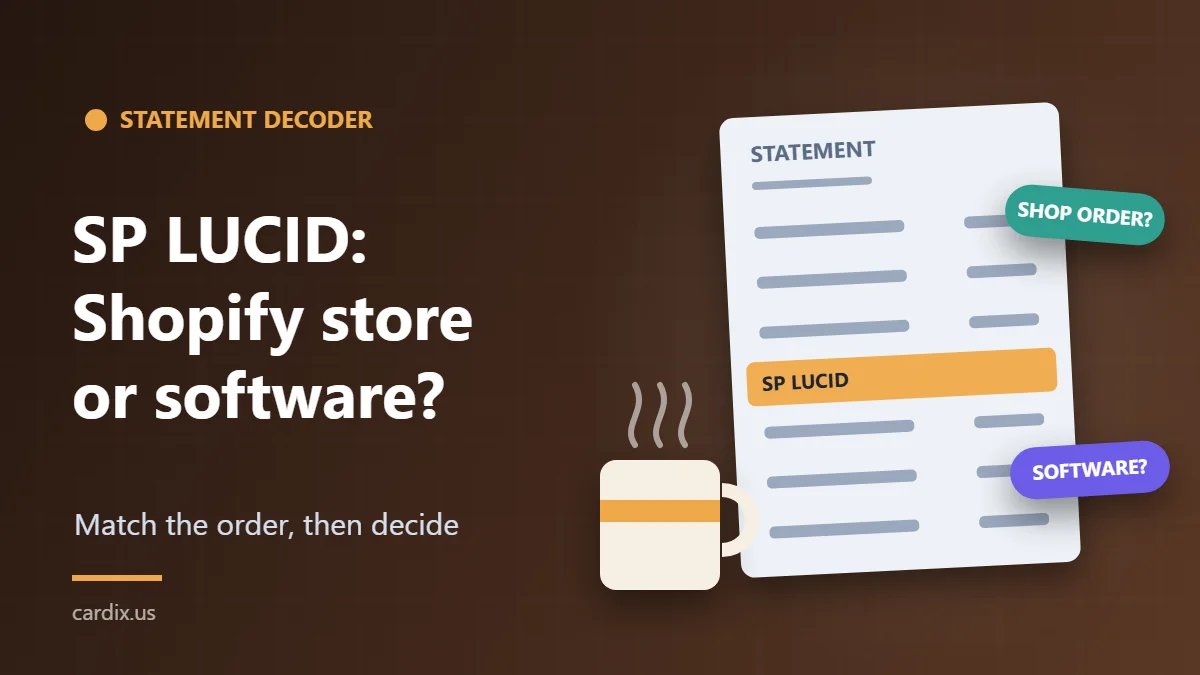
An “SP LUCID” line on your credit card statement almost always points to an online purchase from a store named something like “Lucid” that takes payments through Shopify Payments. The “SP” part is Shopify’s prefix, and “LUCID” is the store’s name, often shortened. One real store fits that pattern well: the mushroom coffee brand Lucid at becomelucid.com, which runs on Shopify and sells subscriptions. But no public source ties the exact “SP LUCID” descriptor to one company, so treat that as a lead to check, not a final answer.
Below: what the descriptor means, which “Lucid” could be behind it, how to confirm it, and what to do if you never made the purchase.
What “SP” Means at the Start of a Charge
Shopify’s help center says that when you buy from a store that uses Shopify Payments, the charge shows up as SP * followed by the store name. Shopify only processes the payment; the shop is the business you actually paid.
That same page notes that Shopify’s own bills to merchants look different: “SHOPIFY *” followed by a nine-digit bill number. So if you’re a shopper and you see “SP LUCID,” you paid a store, not Shopify.
Descriptors are short, so a store called “Lucid Superfoods” or “Lucid Studio” could appear as just “SP LUCID.”
Which “Lucid” Could It Be? What We Could and Couldn’t Verify
Several unrelated businesses use the Lucid name. Here’s how they compare, based on what we could check in November 2026.
| Business | Uses Shopify? | How it usually bills | Fit with “SP LUCID” |
|---|---|---|---|
| Lucid (becomelucid.com), nootropic mushroom coffee | Yes, confirmed in the site’s code | One-time orders and subscriptions | Strong possibility, not confirmed |
| Lucid Software (Lucidchart, Lucidspark) | Not as a store checkout | Its help page says charges include “Lucid” or appear as “lucidchart.com/charge” | Unlikely to carry an SP prefix |
| Lucid Motors (EV charging) | No public evidence | Owners on forums describe temporary holds at charging sessions | Unlikely |
| Other small “Lucid” shops | Possible | Varies | Possible |
The coffee brand
The site becomelucid.com runs on Shopify. Its page code names a “becomelucid.myshopify.com” store, and its terms of service name the operator as Lucid Superfoods, LLC. The store sells mushroom coffee, matcha and similar products, and its footer has a “Manage Your Subscription” link. A recurring delivery could explain a charge you don’t remember.
Lucid Software
Older articles, including a previous version of this page, said SP LUCID is Lucid Software. We couldn’t confirm that. Lucid’s own billing help article says its charges include “Lucid” in the name or appear as “lucidchart.com/charge”, and it doesn’t mention an SP prefix. If you see “lucidchart.com” or “Lucid Software,” that’s the diagramming company.
How to Identify the SP LUCID Charge in 10 Minutes
- Note the exact amount, date and any extra text. Open the transaction in your banking app. Many apps show a fuller merchant name or website.
- Search your email for “Lucid.” Also try “order confirmation,” “your subscription,” and “shipped” around the charge date. The receipt comes from the store, not Shopify.
- Check Shop Pay or the Shop app if you use them. If you checked out with Shop Pay, your order history may list the store by its full name.
- Think about subscriptions. A charge that repeats every month or every few weeks for a similar amount often means an auto-ship order you signed up for at checkout.
- Ask the people who share your card. A partner, teenager, or coworker may have ordered coffee, supplements, or a gift.
- Call your card issuer. The number on the back of your card reaches people who can often see more merchant details.
If It’s a Lucid Coffee Order or Subscription
If you trace the charge to becomelucid.com, contact the store first. It’s usually faster than a dispute. According to its posted refund policy (as of November 2026):
- Returns start by emailing shop@becomelucid.com, within 30 days of delivery.
- Sale items and gift cards can’t be returned.
- Approved refunds go back to the original payment method within 10 business days.
- First-time subscribers get a “Lucid Guarantee”: a refund for one opened bag or product, reported within 30 days of delivery.
To stop future charges, use the store’s “Manage Your Subscription” link before the next billing date. Save the confirmation email, and check current policies first.
If You Didn’t Make the Purchase
If nobody in your household recognizes the order, treat it as possible fraud. Small, odd charges are sometimes “test” purchases made with a stolen card number before bigger ones. Our guide to common credit card fraud types explains how this works.
- Call your issuer right away. Report the charge, ask for a new card number, and turn on transaction alerts.
- Send a written dispute if needed. The FTC explains that a billing-error letter must reach your issuer within 60 days after the first bill showing the error. The issuer must acknowledge it within 30 days and resolve it within 90. You can withhold payment on the disputed amount while it’s investigated.
- Know your liability limit. The CFPB says your liability for unauthorized credit card use is capped at $50, and is generally zero if only your card number was stolen.
Debit cards follow different rules with tighter deadlines, so report debit charges even faster.
How SP LUCID Compares to Other “SP” Charges
Every “SP” descriptor works the same way: a Shopify-powered store with a shortened name. What differs is how easy the store is to find. “SP LUCID” has at least one strong candidate, while others are harder to pin down. See our guides to SP Rescue, SP G2G Ventures, and SP Freebird for other examples.
FAQs
Is SP LUCID a scam?
The descriptor itself isn’t a scam. It’s a standard Shopify Payments label. Whether your specific charge is legitimate depends on whether you or someone you trust placed the order.
Can Shopify refund an SP LUCID charge?
Usually not. Shopify processes the payment, but the store controls refunds. Contact the store first, then your card issuer if the store won’t help.
Why didn’t I get a receipt?
It may be in spam or an old inbox, or someone else used your card. No record at all? Call your issuer.
This article is general information, not financial or legal advice. Check details with your card issuer.

Emma Rose is a U.S.-based personal finance writer and a regular contributor at Cardix.us. She focuses on topics like credit cards, credit scores, and everyday money management. Emma’s writing makes complex financial concepts simple and practical, helping readers make smarter credit and spending decisions with confidence.