
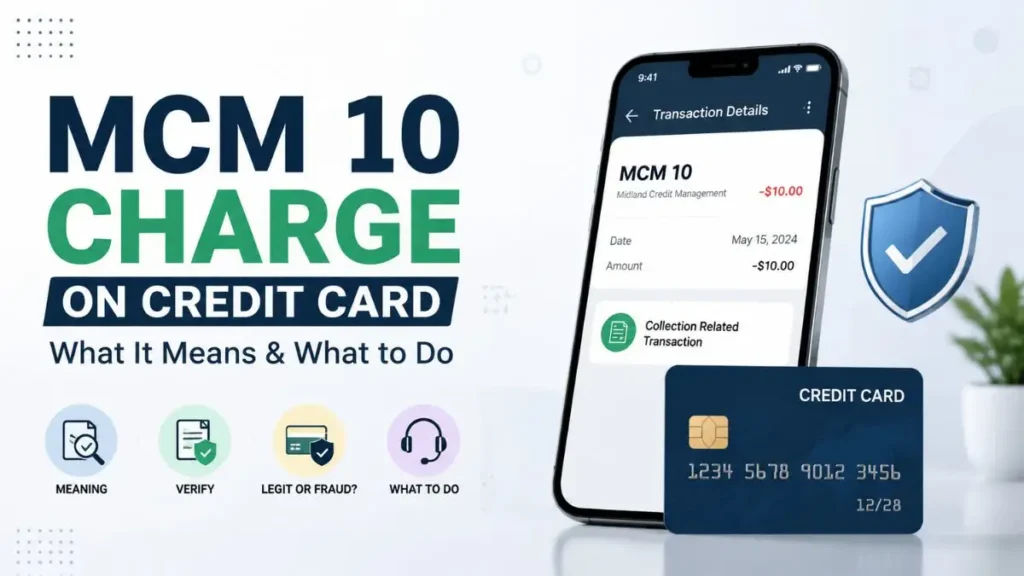
If you see an MCM 10 charge on credit card, it usually refers to a billing descriptor linked to Midland Credit Management (MCM), a U.S.-based debt collection company. This charge often confuses users because it does not look like a normal purchase or subscription.
In most cases, this transaction appears when a payment, settlement, or collection-related activity is processed through MCM. If you do not recognize it, it is important to verify the source before taking any action.
What is Midland Credit Management (MCM)?
Midland Credit Management (MCM) is a legitimate debt buyer and collection agency in the United States. It is a subsidiary of Encore Capital Group, one of the largest debt purchasing companies in the country.
When banks or lenders are unable to recover unpaid debts, they often sell those accounts to MCM. After that, MCM takes responsibility for collecting the outstanding balance from consumers.
They typically handle debts from:
- Credit cards
- Personal loans
- Retail store cards
- Medical bills
- Telecom or utility accounts
Why Does MCM 10 Charge Appear on Your Statement?
The MCM 10 charge on credit card is not a product or service. It is a billing descriptor used by banks and payment processors.
This charge may appear for several reasons:
- A small payment toward an old debt (such as $10)
- A partial settlement or installment payment
- An internal reference code used in processing
- A shortened name for “Midland Credit Management”
Because banks often abbreviate merchant names, “Midland Credit Management” may appear simply as MCM 10 or a similar variation.
Common Sources of MCM Charges
An MCM-related charge usually comes from an unpaid or overdue financial account that was transferred to collections. Common sources include:
- Credit cards (Chase, Capital One, Citi, American Express)
- Retail store cards (Amazon, Macy’s, Synchrony Bank)
- Personal loans
- Medical bills
- Telecom or utility bills
If any of these accounts were unpaid for a long time, they may have been sold to MCM for collection.
How Does a Debt Reach MCM?
Here is how the process typically works:
- You miss payments on a loan or credit card
- The account becomes delinquent (usually after 90–180 days)
- The bank “charges off” the debt as a loss
- The debt is sold to Midland Credit Management
- MCM begins collection efforts and may report activity to credit bureaus
If you make a payment, it may show on your statement as an MCM 10 charge on credit card.
Is MCM 10 Charge Legit or Fraud?
Legit situations:
- You have an old unpaid debt
- You agreed to a repayment plan with MCM
- The collection account appears on your credit report
Suspicious situations:
- You do not recognize any debt
- No MCM entry exists on your credit report
- The charge appears without authorization
MCM itself is a legitimate company, but any unknown transaction should always be verified.
How to Verify MCM 10 Charge
If you are unsure about the charge, follow these steps:
- Check your credit reports (Experian, Equifax, TransUnion)
- Look for any account under Midland Credit Management
- Review past credit cards, loans, or unpaid bills
- Check your bank statement for full transaction details
- Contact MCM and request debt validation
Under U.S. consumer protection laws, you have the right to ask for proof before paying any collection debt.
What If You Don’t Recognize the Charge?
If the charge seems unfamiliar:
- Contact your bank and dispute the transaction
- Request full merchant information
- Ask MCM for written debt validation
- Monitor your credit report for errors
- Consider placing a fraud alert if necessary
Do not ignore the charge until you confirm its origin.
How to Deal with MCM If the Debt is Real
If the debt is valid, it is better to resolve it instead of ignoring it. MCM usually offers flexible options such as:
- One-time settlement offers
- Monthly payment plans
- Reduced payoff amounts in some cases
Before paying:
- Always request a written agreement
- Keep all payment receipts
- Keep all payment receipts
Frequently Asked Questions (FAQs)
What is MCM 10 charge on credit card?
It is a billing descriptor linked to Midland Credit Management, usually related to debt collection or payment activity.
Is Midland Credit Management legit?
Yes, MCM is a legitimate U.S. debt collection company.
Can I dispute an MCM charge?
Yes, you can dispute it through your bank and request debt validation.
Why is MCM on my credit card statement?
It appears when a debt payment or collection-related transaction is processed.
Conclusion
The MCM 10 charge on credit card is most commonly related to Midland Credit Management, a legitimate debt collection agency in the U.S. It is not a shopping or subscription charge. In most cases, it reflects a debt-related transaction or payment activity.
Before taking action, always verify the charge through your bank and credit report. If it is valid, consider resolving it responsibly. If not, dispute it immediately to avoid any financial issues.
Read Also:-Advanced Technology Group Charge on Credit Card

Emma Rose is a U.S.-based personal finance writer and a regular contributor at Cardix.us. She focuses on topics like credit cards, credit scores, and everyday money management. Emma’s writing makes complex financial concepts simple and practical, helping readers make smarter credit and spending decisions with confidence.