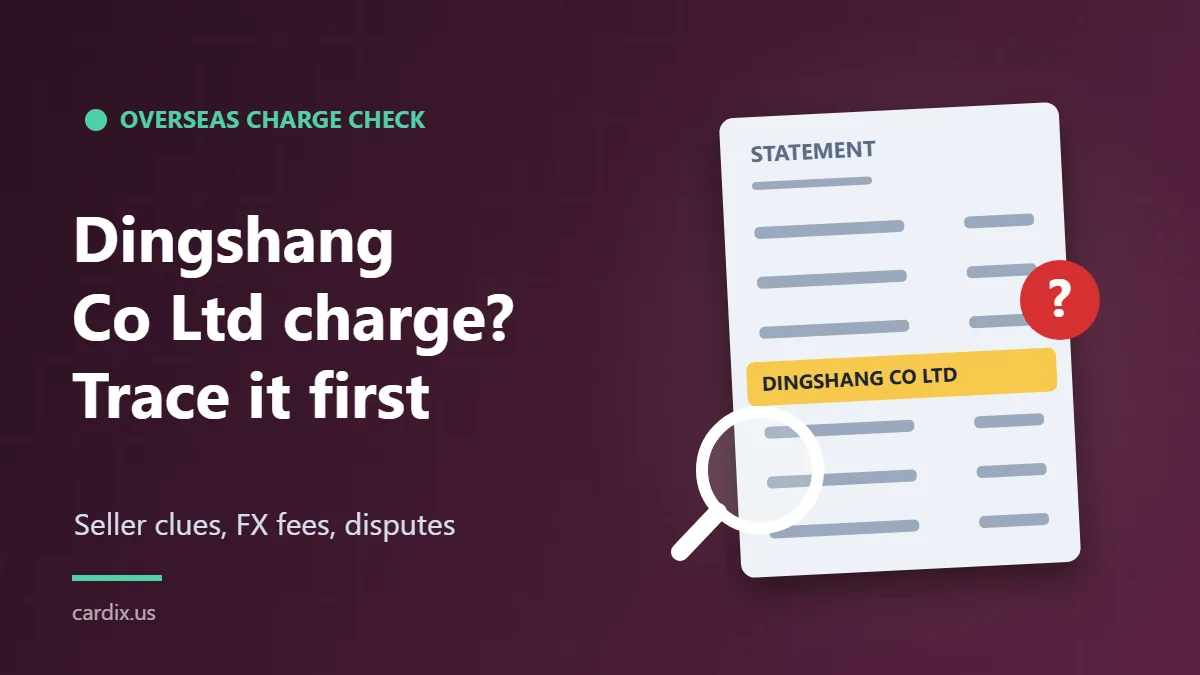
If “DINGSHANG CO LTD” just showed up on your credit card statement, here is the honest answer first: we could not tie this descriptor to one specific store, app or brand. Several unrelated businesses use the Dingshang name, so the name alone won’t tell you who charged you. The good news is that the transaction details your bank already has usually will. Below: how to trace it, what an overseas purchase costs in fees, and how to dispute it from the U.S.
What we could and could not verify
Here is what our search of seller listings, trade directories and forums turned up.
| What we checked | What we found |
|---|---|
| Business and trade listings | Several unrelated China-based companies with “Dingshang” in their names, including a Shenzhen technology firm and a Zhongshan lighting maker, plus a Singapore company called Ding Shang Pte. Ltd. registered in 2025 |
| Apple App Store seller names | No app sold under “Dingshang Co., Ltd.” |
| Reddit and consumer forums | No threads about this exact charge |
None of those companies is confirmed as the one on your statement, and we are not suggesting any of them did anything wrong. Treat the name as a clue, not an answer.
What “Co Ltd” tells you about the charge
“Co., Ltd.” is a common English suffix for companies registered in mainland China and other Asian markets. Hong Kong companies more often end in “Limited.” Combined with a Chinese name like Dingshang, the descriptor strongly suggests a foreign seller.
That matters because the shop you remember may be just a store name, while the statement shows the legal company behind it. Foreign merchants also add fees and weaken some dispute options.
Common reasons a charge like this appears
These are possibilities, not confirmed explanations for your charge:
- A store you found through a social media ad. Many small shops advertised on Facebook, Instagram or TikTok are run by overseas companies.
- A mobile game or app purchase. Some apps bill directly instead of through Apple or Google, so the developer’s legal name appears.
- A recurring subscription. A cheap trial can roll into a monthly charge under a name you never saw at checkout.
- Card testing or fraud. A small, odd amount you don’t recognize can be a thief checking whether a stolen card number works.
How to trace who actually charged you
- Open the transaction in your bank app. Look for the merchant city, country, phone number or website.
- Check for a currency hint. If the amount is uneven (like $27.43) or a separate foreign transaction fee posted next to it, the seller was likely paid in another currency or is based abroad.
- Search your email by amount and date, not by the merchant name. Order confirmations rarely say “Dingshang.”
- Review subscriptions in your iPhone or Android settings, PayPal account and any shopping apps you used around that date.
- Call your card issuer and ask for the full merchant details, including the merchant category and location.
If one of these steps matches the charge to a real order, contact that store first. A refund straight from the seller is usually faster than a dispute.
The hidden cost: foreign transaction fees
Even when the purchase is legitimate, buying from a non-U.S. company can cost more. A foreign transaction fee is typically 1% to 3% of the purchase, and some issuers charge it on online buys from overseas merchants even when you never left home. If you see a small extra line next to the Dingshang charge, that is probably it.
If you get a full refund or win a dispute, ask your issuer whether the related fee will be reversed too. Policies vary by issuer, so don’t assume it happens automatically.
How to dispute the charge from the U.S.
If you never authorized it
Call your issuer, report the charge as fraud and ask for a new card number. Under federal rules, if only your card number was stolen, you generally have no liability for unauthorized charges.
If you ordered something that never arrived
This counts as a billing error. Put your dispute in writing and make sure it reaches the issuer’s billing-inquiry address within 60 days after the first bill showing the charge was sent. The issuer must acknowledge it within 30 days and resolve it within 90. You can withhold the disputed amount while it investigates, but keep paying the rest of your bill.
If the item arrived but was fake or damaged
This is the harder case with a foreign seller. The federal right to raise quality problems with your issuer generally applies only to purchases over $5 made in your home state or within 100 miles of your billing address, and an overseas web shop usually fails that test. Ask your issuer anyway, since card network chargeback rules may still help. Keep screenshots, tracking numbers and messages.
Report it abroad, too
If you believe the seller scammed you, file a report at econsumer.gov, a network of more than 65 consumer protection agencies. It won’t recover your money, but it helps agencies spot repeat offenders.
Red flags that point to fraud
- No order, email or app download matches the date or amount.
- Several small charges in a row, or one tiny charge followed by a bigger one.
- The charge keeps repeating after you asked the seller to cancel.
Any one of these is a good reason to call your issuer the same day.
Quick answers
Is a Dingshang Co Ltd charge a scam?
Not necessarily. It can be a real purchase from an overseas seller. But because no consumer brand clearly bills under this name, treat it as unverified until you match it to an order.
Will disputing it hurt my credit score?
No. A dispute is not a late payment. While a billing-error dispute is open, the issuer can’t report the disputed amount as delinquent.
Seeing other Asia-based names on your statement? Compare our guides to the HK Henghao Metal Mater charge, the Bingchuan Network charge from a game publisher, and the Airwalxhk charge tied to a payment processor.
This article is general information, not financial or legal advice. Check your cardholder agreement and talk with your issuer about your specific charge.

Emma Rose is a U.S.-based personal finance writer and a regular contributor at Cardix.us. She focuses on topics like credit cards, credit scores, and everyday money management. Emma’s writing makes complex financial concepts simple and practical, helping readers make smarter credit and spending decisions with confidence.