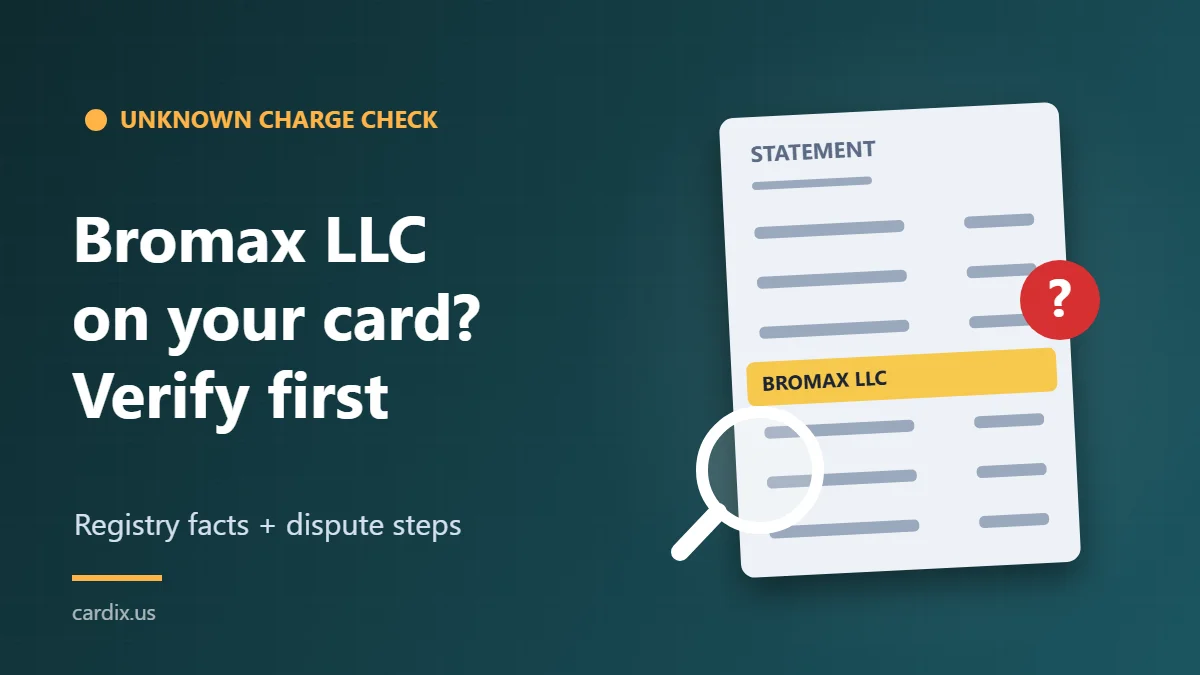
If “BROMAX LLC” showed up on your credit card statement and you can’t place it, here’s the short answer: the only Bromax LLC we could confirm in an official U.S. business registry is a small West Virginia company. Nothing public shows that this company bills consumer cards, and no merchant directory or consumer complaint database we checked links the name to a specific store or service. Treat the charge as unidentified until your own records or your card issuer match it to a purchase.
Below: what the records show, why a bare LLC name appears, and how to confirm or dispute the charge.
What the Public Records Show About Bromax LLC
We searched the West Virginia Secretary of State’s business database in November 2026. It lists one entity named BROMAX LLC:
- A domestic, for-profit limited liability company formed on September 6, 2017
- Chartered in Raleigh County, with its principal office in Midway, West Virginia
- Registered business purpose: local messengers and local delivery (transportation and warehousing)
- Annual reports on file for every year from 2018 through 2026, with no termination recorded
That’s all the registry confirms. It doesn’t say the company accepts card payments, what it sells to the public, or which name it uses on statements. We found no official website, no Better Business Bureau profile and no card-network merchant listing for “Bromax LLC.” We also found no forum threads about this charge.
Some websites say Bromax LLC is a gas station operator in Arizona or West Virginia. We couldn’t verify that claim in any registry or official source, so we don’t repeat it as fact. Similar names exist, such as Bromax Contracting LLC in Minnesota and Brumax LLC, so check spelling carefully.
Why an LLC Name Appears Instead of a Store Name
Every card transaction carries a merchant descriptor, which is the text your bank prints on the statement. Merchants or their payment processors set it. When a small business never sets a custom descriptor, the processor often falls back to the company’s legal name. That’s why you might buy something from a shop with one name on its sign and see an unfamiliar “LLC” on your bill.
This is common with small local businesses and delivery services. Your purchase may have come from a business operating under Bromax LLC, but that’s only a possibility. A legal name doesn’t prove the charge is legitimate or fraudulent.
How to Figure Out If You Made the Purchase
Work through these checks before calling anyone.
- Read the full transaction details. Open the charge in your card’s app. Many issuers show a city, phone number, merchant category or map pin. A Midway or Beckley, West Virginia location is a strong clue.
- Match the date and amount. Search your email, texts and receipts for that exact amount. Tips added later can make the final charge slightly higher than the receipt.
- Think about local spending. If you live in or traveled through southern West Virginia, list any deliveries, local services or small shops you paid around that date.
- Ask other cardholders. Authorized users and family members with saved card details often explain “mystery” charges.
- Search the exact descriptor. Discover recommends searching the merchant name exactly as it appears, along with checking receipts and asking authorized users. Include any numbers or city that follow “BROMAX.”
- Look at pending versus posted. A pending charge that drops off within a few days may just be a temporary authorization hold.
Signs the Charge May Be Unauthorized
Be more cautious if any of these apply:
- You’ve never been to West Virginia and don’t use local delivery or courier services
- The charge is very small (like $1 to $5) and followed by larger ones, a common card-testing pattern
- The charge repeats monthly and you never signed up for anything
Fraudsters sometimes run stolen card numbers through real merchant accounts. So even if a legitimate company’s name appears, the transaction itself can still be unauthorized.
How to Dispute a Bromax LLC Charge
Step 1: Call the number on the back of your card
Say you don’t recognize the charge and ask for any merchant details they have, such as an address, phone number or category code. If you suspect fraud, ask them to lock or replace the card.
Step 2: Contact the merchant only if you can verify it
If those details match a business you used, ask it for a receipt or refund. Don’t call numbers from unverified websites, and never give your full card number to someone who calls you.
Step 3: File a billing dispute in writing
Under the Fair Credit Billing Act, the FTC explains that your dispute must reach the issuer within 60 days after the first statement showing the error was sent. Use the billing-inquiries address. Include your name, account number, the charge date and amount, and why it’s wrong. The issuer must acknowledge it within 30 days and resolve it within 90 days. While it investigates, you can withhold payment on the disputed amount but must pay the rest of your bill.
Step 4: Know your liability limits
According to the Consumer Financial Protection Bureau, if only your card number was stolen and you still have the card, you generally owe nothing for unauthorized charges. If the physical card was lost or stolen and used before you reported it, federal law caps your liability at $50, and many cardholder agreements waive even that.
How to Prevent Charges Like This
- Turn on real-time transaction alerts in your card’s app so you see charges within minutes.
- Review statements line by line each month, especially small charges.
For more context, see our guides on common credit card fraud types, the Corporate Filings LLC charge, the ITX USA LLC charge and the Cloudary Holdings charge, all of which also involve LLC-style descriptors.
Frequently Asked Questions
Is Bromax LLC a scam?
There’s no public evidence that it is. The West Virginia entity keeps its filings current. Since we can’t confirm it’s behind your charge, judge the transaction, not the name.
Will disputing hurt my credit?
Filing a dispute isn’t a late payment, and the issuer can’t report the disputed amount as delinquent while it investigates.
This article is general information, not legal or financial advice. Check your cardholder agreement for your specific protections.

Emma Rose is a U.S.-based personal finance writer and a regular contributor at Cardix.us. She focuses on topics like credit cards, credit scores, and everyday money management. Emma’s writing makes complex financial concepts simple and practical, helping readers make smarter credit and spending decisions with confidence.