
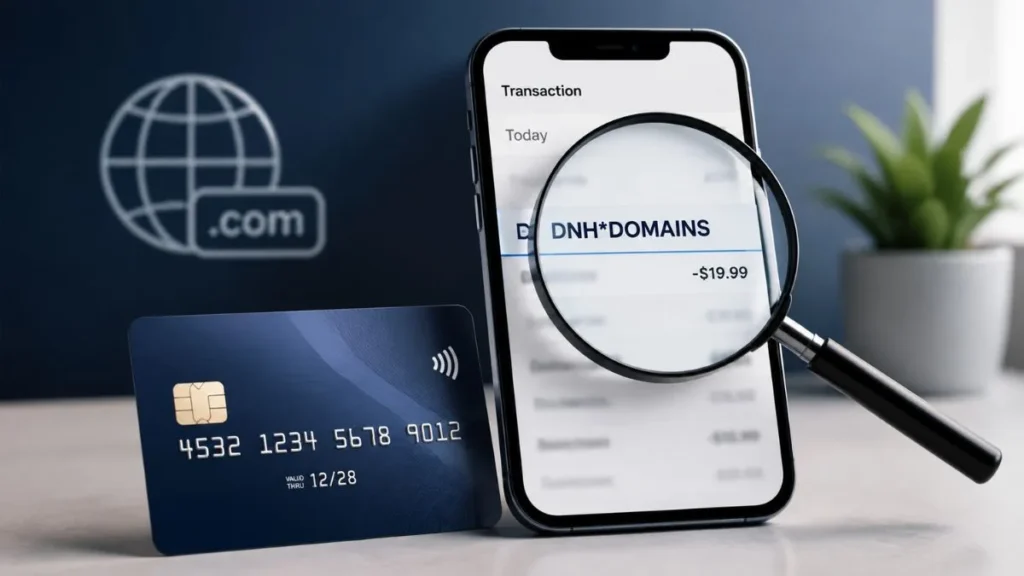
If you noticed a dnh domains charge on credit card, you may be wondering where it came from and whether it is legitimate. The DNH* billing descriptor is commonly associated with GoDaddy transactions and may relate to a domain purchase, renewal, hosting, email, SSL, or another website service. However, a DNH charge is not automatically a scam or necessarily a domain renewal. Here is how to identify it and what to do if you do not recognize the payment.
What Is a DNH Domains Charge on a Credit Card?
A DNH Domains charge is a billing descriptor that may appear on your credit card statement for a domain or other website-related service. GoDaddy officially confirms that many of its card-sale descriptors begin with DNH*. Some newer descriptors may also contain an order number, which can help you locate the transaction in your GoDaddy Order History.
Your statement may show a billing descriptor instead of the exact product name you remember. For example, you may remember purchasing a domain while your bank statement displays a DNH-related description.
Is DNH Domains the Same as GoDaddy?
Not necessarily. DNH* is commonly associated with GoDaddy card transactions, and descriptors such as DNH GODADDY.COM are recognizable as GoDaddy-related billing descriptions.
However, the descriptor alone does not prove exactly which company, product, or service generated every DNH-related transaction. The safest approach is to verify the charge using the transaction date, amount, and any order number shown on your statement.
Why Did I Get a DNH Domains Charge?
A DNH-related charge can have several legitimate explanations.
Domain Registration
If you recently purchased a domain, the payment may appear with a DNH-related billing descriptor instead of the domain name itself.
Domain Renewal
An existing domain may have been renewed for another registration period. Check whether the charge date matches your domain’s renewal date.
Automatic Renewal
If automatic renewal is enabled, a saved payment method can be charged when a domain or subscription reaches its renewal date. This is especially easy to forget when the original purchase was made months or years ago.
Web Hosting
The payment may be for website hosting or another managed website service rather than the domain itself.
Professional Email
A business email service connected to your domain can also create recurring charges.
SSL or Security Services
The charge may relate to an SSL certificate, website security, backup, or another website protection product.
Why Does My Credit Card Say “DNH” Instead of GoDaddy?
Credit card statements use merchant or billing descriptors to identify transactions. These descriptors do not always match the brand or product name customers remember.
GoDaddy states that many of its card-sale descriptors begin with DNH*. Depending on the transaction, your statement might show examples such as:
DNH*GODADDY.COMDNH GODADDY.COMDNH*GODADDY.COMwith additional billing informationDNH*followed by an order number
The exact format can vary depending on the payment method, payment processor, and card-issuing bank.
Is a DNH Domains Charge Legitimate or a Scam?
A DNH Domains charge is not automatically a scam. It may be a legitimate GoDaddy-related payment if you own a domain, use hosting or email services, have automatic renewal enabled, or authorized someone else to use your card.
The charge deserves further investigation if you cannot find a matching order, do not have any related services, nobody authorized the purchase, or the merchant cannot identify the transaction.
An unfamiliar charge should be verified before you assume it is either legitimate or fraudulent.
How to Check a DNH Domains Charge
Follow these steps to identify the payment:
Check the Transaction Date
Compare the date on your credit card statement with your recent purchases and renewals.
Check the Exact Amount
Look for an order with the same amount in your GoDaddy account.
Check the Order Number
If your statement includes an order number after DNH*, use the available portion to help locate the transaction.
Review GoDaddy Order History
Sign in to your account and compare the date, amount, and order information with your purchases.
Check Other Accounts
If you have multiple GoDaddy accounts, review each one. An older account may contain the domain or subscription responsible for the charge.
Ask Other Authorized Users
A family member, coworker, or business partner with access to the card may have made the purchase.
What If I Don’t Recognize the Charge?
If you cannot find the transaction, search your email for terms such as GoDaddy, domain renewal, order confirmation, hosting, or renewal. An old receipt may reveal what generated the payment.
You can also contact GoDaddy and provide the transaction date, amount, and statement descriptor. If the charge cannot be verified and you did not authorize it, contact your credit card issuer and ask about its process for reporting or disputing an unauthorized transaction.
Can I Get a Refund for a DNH Domains Charge?
A refund is possible in some circumstances, but it is not guaranteed. First determine what the charge was for and whether it was a legitimate purchase or renewal. Then contact the merchant about applicable refund options.
Also, do not confuse a pending transaction with a completed charge. A pending authorization or refunded transaction can sometimes remain visible on a statement temporarily.
Frequently Asked Questions
What is DNH Domains on my credit card?
It is a billing descriptor that may be associated with domain, hosting, or other website-related services. DNH* is also commonly used in GoDaddy card billing descriptors.
Is DNH a GoDaddy charge?
DNH* is commonly associated with GoDaddy transactions, but the descriptor alone does not identify the exact product or transaction.
Can DNH be a domain renewal?
Yes. A DNH-related charge can be associated with a domain renewal, but it may also relate to hosting, email, SSL, or another website service.
Is a DNH charge fraudulent?
Not necessarily. Verify the transaction through your account and statement details before deciding whether it is unauthorized.
Bottom Line
A dnh domains charge on credit card is commonly associated with domain and website-related billing, including GoDaddy transactions. It may be a domain purchase, renewal, hosting, email, SSL, or another service. If you do not recognize the charge, compare the date, amount, and order number with your GoDaddy Order History. If you still cannot verify it, contact GoDaddy and, if necessary, your credit card issuer.
Read Also:-Buffalo Wild ECOM Charge on Credit Card

Emma Rose is a U.S.-based personal finance writer and a regular contributor at Cardix.us. She focuses on topics like credit cards, credit scores, and everyday money management. Emma’s writing makes complex financial concepts simple and practical, helping readers make smarter credit and spending decisions with confidence.