
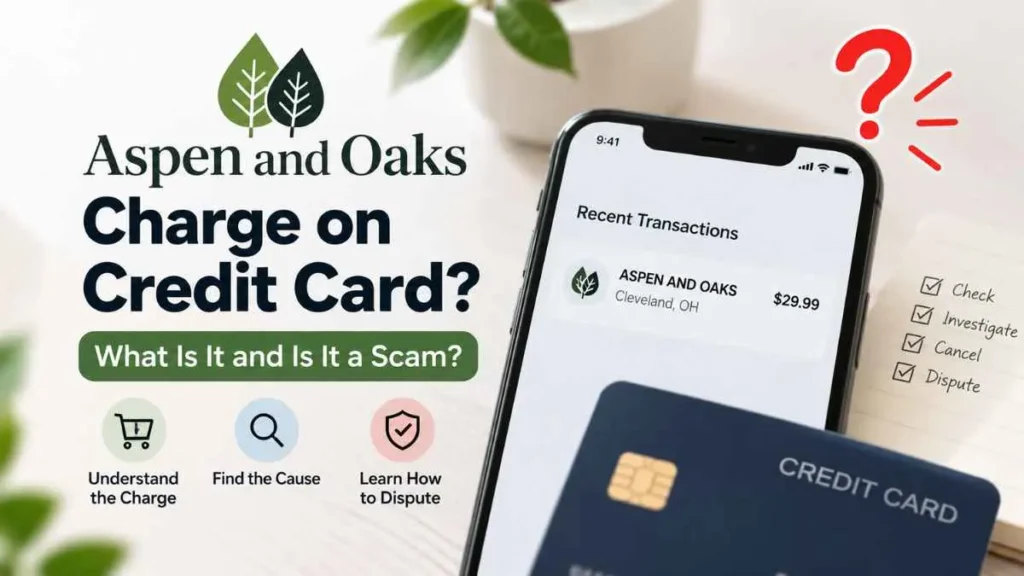
Seeing an unfamiliar Aspen and Oaks charge on your credit card can be concerning, especially if you do not remember making a purchase from the company. Consumer complaints commonly mention a $29.99 charge, sometimes described as a VIP, membership, or recurring fee. But an unfamiliar charge is not automatically proof of fraud.
In this guide, you’ll learn what the Aspen and Oaks charge may mean, why $29.99 appears frequently in reports, how to trace the transaction, and what to do if you believe the charge is unauthorized.
What Is the Aspen and Oaks Charge?
Aspen and Oaks may appear on a credit-card statement as a merchant or billing descriptor. You may also see variations such as:
- Aspen & Oaks
- Aspenandoaks.com
- Aspen and Oaks Cleveland OH
The statement name may not be identical to the store or website where you originally purchased something.
Based on consumer reports, an Aspen and Oaks transaction may potentially relate to a membership, VIP program, recurring subscription, or an earlier online purchase. It may also be unauthorized if you cannot connect it to anything you knowingly approved.
Why Is the Aspen and Oaks Charge Often $29.99?
$29.99 is the most commonly reported amount in the consumer complaints reviewed. Several BBB reports describe $29.99 Aspen and Oaks charges, including reports involving recurring monthly billing.
One BBB report describes four $29.99 charges totaling $119.96 between October 2025 and January 2026. The consumer said they had not knowingly signed up for a monthly subscription.
However, do not assume Aspen and Oaks always charges $29.99. The amount is a reported pattern, not a guaranteed fixed price.
Why Did Aspen and Oaks Charge My Card?
There are several possible explanations.
You Previously Bought Something Online
Some complaints describe an earlier purchase from another online store followed by a charge under a different merchant name.
One reported sequence was:
Oak and Cedars → Ash and Hollows → Aspen and Oaks
In that complaint, the consumer said they were told the later $29.99 charge was connected to a VIP membership.
You May Have Been Enrolled in a Membership
Related consumer complaints mention VIP, Platinum, and recurring memberships. Some consumers say they did not remember agreeing to them.
In related BBB complaints, business responses have stated that disputed $29.99 charges represented membership fees and that some memberships were cancelled and refunded.
You May Not Recognize the Billing Descriptor
Your statement may show a name different from the website you remember. Check your email receipts, order history, and recent online purchases before assuming the charge is fraudulent.
Another Authorized User Made the Purchase
Check whether a spouse, family member, employee, or another authorized cardholder made the original purchase.
The Charge May Be Unauthorized
If there is no matching purchase, membership, receipt, or authorized user, investigate the transaction immediately and contact your credit-card issuer.
How the Aspen and Oaks Charge Pattern Reportedly Works
Some consumer reports describe this general sequence:
Online ad or inexpensive product → purchase → possible membership terms → product received → weeks later $29.99 charge → Aspen and Oaks appears on statement
This is a reported pattern, not proof that every Aspen and Oaks transaction follows the same sequence.
Are Aspen and Oaks and Similar Merchant Names the Same Business?
Consumers have reported Aspen and Oaks alongside names such as Cedar & Ash, Oak and Cedars, Ash and Hollows, and Timber and Oaks.
These reports show overlapping billing patterns, but they do not conclusively establish that every similarly named storefront is the same legal entity. A similar name or charge amount is not enough to prove common ownership.
Is Aspen and Oaks a Scam or Legit?
The safest answer is: an Aspen and Oaks charge is not automatically proof of a scam, but multiple consumers have reported unexpected or disputed $29.99 membership charges.
Reasons for concern include recurring charges, disputed memberships, and consumers who say they never purchased from Aspenandoaks.com.
At the same time, some related business responses have described disputed charges as membership fees and reported cancelling memberships or issuing refunds. BBB complaints are consumer reports, not court findings.
Therefore, it is more accurate to describe an unfamiliar charge as potentially unauthorized or disputed rather than automatically calling it a scam.
What If I Never Bought Anything From Aspen and Oaks?
Not recognizing Aspen and Oaks does not necessarily mean you never made the original purchase.
Check whether you:
- Bought from another online store
- Used a social-media advertisement
- Purchased a discounted product
- Have another authorized card user
- Accepted a membership without realizing it
If none of these explains the charge, contact your card issuer.
How to Check Where the Charge Came From
Use this quick checklist:
- Check your last 2–3 card statements for Aspen and Oaks, Aspenandoaks.com, or repeated $29.99 charges.
- Search your email for “Aspen,” “Oaks,” “Cedar,” “Ash,” “VIP,” “Platinum,” “membership,” “subscription,” and “$29.99.”
- Review online purchases, especially orders made through social-media advertisements.
- Ask authorized users whether they made the purchase.
- Contact your card issuer if you still cannot identify the transaction.
How to Cancel and Dispute the Charge
If the charge is connected to a membership you do not want, request cancellation and ask for written confirmation. Also request a refund if you believe the charge was not knowingly authorized.
If you cannot identify or authorize the transaction, contact your credit-card issuer promptly and ask about disputing it. Keep screenshots, receipts, emails, cancellation requests, and merchant responses.
For U.S. credit-card billing errors, the CFPB advises sending a written billing-error notice within 60 calendar days after the statement containing the error was sent to protect your rights under the billing-error process.
Should You Replace Your Credit Card?
Not necessarily. First ask your issuer whether replacement is recommended. It may be appropriate if unauthorized charges continue or your card information may have been compromised.
Also ask about available controls for recurring payments and document any dispute.
Final Verdict
The available consumer reports show a recurring $29.99 Aspen and Oaks billing pattern, with some consumers disputing membership enrollment or saying they did not authorize the charges.
However, this does not prove that every Aspen and Oaks transaction is fraudulent.
If you recognize the original purchase, investigate whether a membership was accepted. If you do not recognize the purchase or recurring charge, treat it as potentially unauthorized, document everything, and contact your credit-card issuer promptly.
Frequently Asked Questions
What is the Aspen and Oaks charge on my credit card?
It is a billing descriptor reported by consumers, commonly associated with $29.99 membership or recurring charges.
Why did Aspen and Oaks charge me $29.99?
Reports suggest some $29.99 charges may be connected to memberships or earlier online purchases. Your individual transaction should be verified.
Is Aspen and Oaks a scam?
Not every charge can be classified as a scam. However, multiple consumers have reported unexpected or disputed charges.
Read Also:-ZVIG USA Charge on Credit Card

Emma Rose is a U.S.-based personal finance writer and a regular contributor at Cardix.us. She focuses on topics like credit cards, credit scores, and everyday money management. Emma’s writing makes complex financial concepts simple and practical, helping readers make smarter credit and spending decisions with confidence.