
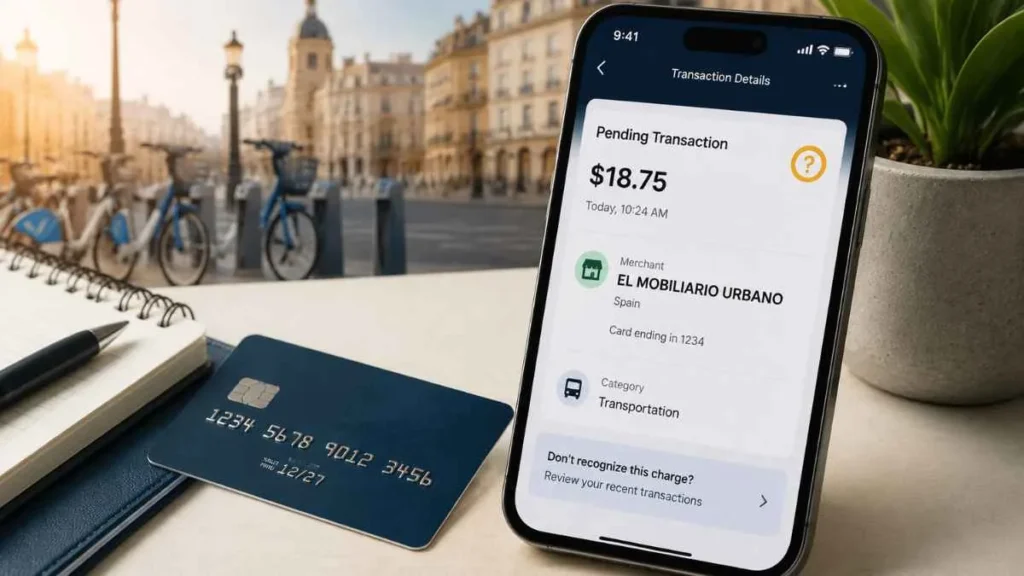
If you see an El Mobiliario Urbano charge on credit card statement, the Spanish name can be confusing, especially for U.S. cardholders. El Mobiliario Urbano is a legitimate Spanish corporate name associated with JCDecaux Spain. Its documented activities include urban-furniture services and public bicycle systems. The charge may be connected to a service such as Valenbisi or Sevici, but the statement descriptor alone cannot confirm the exact purchase.
What Is El Mobiliario Urbano?
“El Mobiliario Urbano” means “urban furniture” in Spanish. It refers to a Spanish corporate entity associated with JCDecaux, a company involved in outdoor advertising and urban services. Spanish government records currently identify El Mobiliario Urbano, SLU as JCDecaux España, SLU.
The term can cover public-space equipment such as bus shelters, information displays, advertising panels, kiosks, and other street furniture. It does not mean every charge under this name is for one of these items.
Is El Mobiliario Urbano a Legitimate Company?
Yes. El Mobiliario Urbano is a legitimate business name with documented corporate and government records. The Spanish government’s 2026 BOE record identifies “El Mobiliario Urbano, SLU” as “currently JCDecaux España, SLU.”
However, a legitimate merchant can still appear on a statement for an unauthorized transaction. You should therefore verify the individual charge rather than assuming it is safe or fraudulent based only on the merchant name.
Why Is El Mobiliario Urbano Charging My Credit Card?
The exact reason depends on the transaction, but a documented consumer-related explanation is a public bicycle service operated through JCDecaux.
Valenbisi Bike-Sharing Charge
Valenbisi is Valencia’s public bicycle-sharing service. JCDecaux says it operates Valenbisi and identifies it as part of its Spanish bicycle-sharing services.
If you visited Valencia and used Valenbisi, an El Mobiliario Urbano charge may be connected to your bicycle account or related service activity.
Sevici Bike-Sharing Charge
Sevici is the public bicycle-sharing service in Seville. JCDecaux also identifies Sevici as one of its Spanish bicycle services.
If you traveled to Seville and used Sevici, check your account, receipts, and travel history before treating the charge as unauthorized.
Other JCDecaux-Related Activity
JCDecaux also operates urban-furniture and outdoor-advertising businesses. A transaction could therefore be related to another JCDecaux business relationship, particularly for companies or advertising customers. For an ordinary consumer, a public bicycle service is a more relevant connection to investigate.
Why Does My Statement Say El Mobiliario Urbano?
Credit-card statements may display a legal entity, merchant account name, parent or subsidiary company, or legacy corporate name instead of the brand a customer remembers.
For example, you may remember using Valenbisi while your statement displays El Mobiliario Urbano. This difference can make a legitimate transaction look unfamiliar.
Is the El Mobiliario Urbano Charge Legitimate?
The company name is legitimate, but the individual transaction may still be unauthorized.
The charge may be legitimate if:
- You recently traveled to Spain.
- You visited Valencia or Seville.
- You used Valenbisi, Sevici, or another related service.
- Another authorized cardholder used the service.
- The date and amount match your travel or account history.
The charge deserves investigation if:
- You have never been to Spain.
- You never used a related bicycle service.
- No authorized cardholder made the transaction.
- The amount or date does not match anything you recognize.
- Multiple unexplained charges appear.
I Don’t Recognize the Charge. What Should I Do?
- Check the date and amount. Compare them with your travel records and receipts.
- Search your email. Look for “El Mobiliario Urbano,” “JCDecaux,” “Valenbisi,” “Sevici,” “Valencia,” “Seville,” “bike,” or “bicycle.”
- Check Apple Pay or Google Pay. This is especially useful if you used a digital wallet while traveling.
- Ask other authorized cardholders. Someone else may have made the purchase.
- Contact your credit-card issuer. If you still cannot identify the charge, ask for the full merchant name, location, country, Merchant Category Code (MCC), transaction type, and available authorization details.
How to Dispute an Unauthorized Charge
If you did not authorize the transaction, contact your U.S. credit-card issuer promptly using the number on the back of your card and ask how to dispute it.
The Consumer Financial Protection Bureau says consumers should notify the card company promptly and send a written billing-error notice within 60 days after the statement containing the error was sent to protect certain billing-error rights. Keep copies of your dispute and continue paying undisputed amounts on time.
If multiple suspicious transactions appear, ask the issuer whether you should replace the card and monitor the account for additional activity.
Could El Mobiliario Urbano Be a Scam?
Not necessarily. There is no basis to label El Mobiliario Urbano itself a scam. It is a legitimate Spanish corporate name associated with JCDecaux. However, a legitimate merchant can still be involved in an unauthorized transaction.
If you never traveled to Spain, never used a related service, and cannot identify the charge, treat the transaction as potentially unauthorized and contact your card issuer.
Bottom Line
An El Mobiliario Urbano charge on credit card statement is not automatically fraudulent. The name is associated with JCDecaux Spain, and documented connections include public bicycle services such as Valenbisi in Valencia and Sevici in Seville. If you recently traveled to Spain, check your bicycle-service accounts and receipts first. If you have no connection to the transaction, ask your credit-card issuer for detailed merchant information and dispute it if it was not authorized.
Read Also:-Factor Law Inc Charge on Credit Card

Emma Rose is a U.S.-based personal finance writer and a regular contributor at Cardix.us. She focuses on topics like credit cards, credit scores, and everyday money management. Emma’s writing makes complex financial concepts simple and practical, helping readers make smarter credit and spending decisions with confidence.