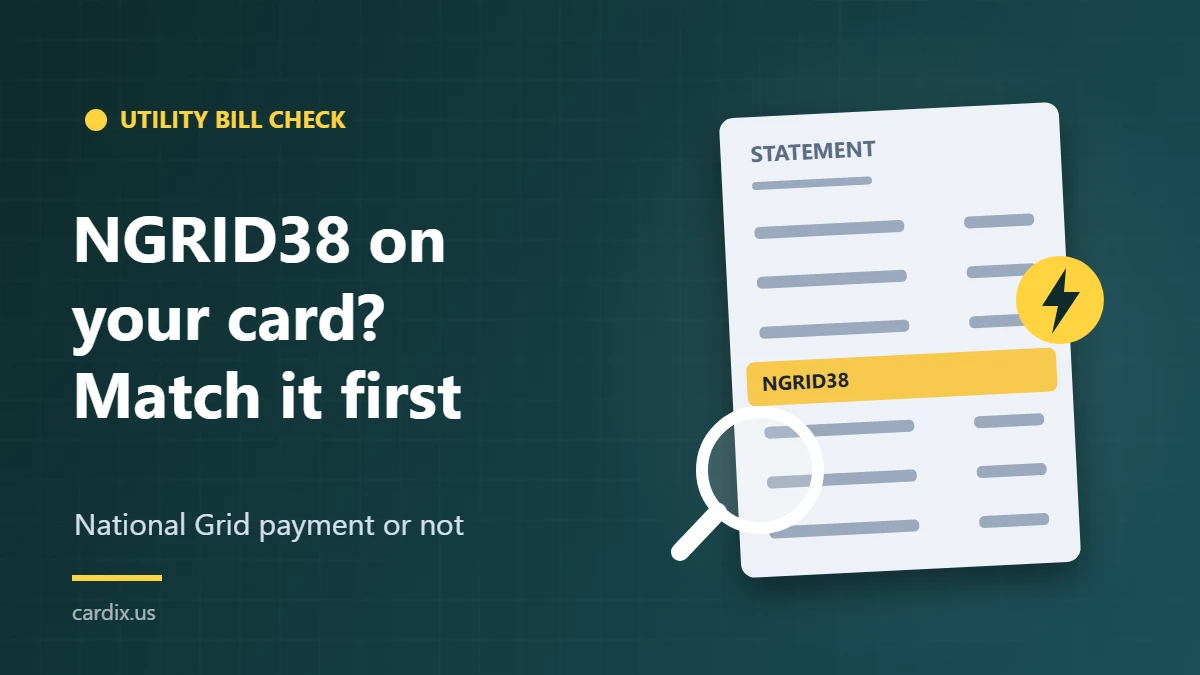
If you see “NGRID38” on your credit card statement, it is most likely a payment to National Grid, the electric and gas utility. “NGRID” is a shorthand National Grid itself uses, and its customers can pay by card. One thing nobody has confirmed publicly, though, is what the “38” means. So don’t take the label’s word for it. Match the charge to your own National Grid account, and dispute it if it doesn’t match.
Below: why the National Grid link is likely, how to check it in minutes, why the amount may exceed your bill, and what to do if you aren’t a National Grid customer.
Why NGRID38 Points to National Grid
Card statements show a short “descriptor” in place of a merchant’s full name, and long names get cut down to fit. “NGRID” is an obvious contraction of National Grid. The company also uses that exact tag itself: its scam alert page says outage text alerts come from short code 64743 labeled “NGRID,” and payment reminders come from 647432 labeled “NGRIDC.”
Here’s what is and isn’t established:
- Confirmed: National Grid takes credit and debit card payments, through a third-party processor called Speedpay.
- Likely: “NGRID38” is one of the ways those payments show up on statements.
- Unknown: what “38” stands for. It could be a location, terminal, or batch code added by the processor, but National Grid doesn’t publish an explanation, and any site claiming a specific meaning is guessing.
Not every National Grid payment carries this label. Crowd-sourced statement lookups show many other versions, such as “SPEEDPAY NATIONAL GRID,” “NATIONAL GRID ONLINE PMT,” and “NATIONAL GRID NY UTILITYPAY.” Your bank’s wording depends on how and where you paid.
How to Match the Charge to Your National Grid Account
This check settles most cases.
- Write down the charge details. Note the date, the exact amount, and whether it’s pending or posted.
- Log in to your National Grid account by typing the address in yourself rather than clicking a link from a text or email. Open your payment history.
- Look for a card payment on or near that date. Check a few days on either side.
- Compare the amounts. If the card charge is your payment plus a small extra, that extra is probably the card processing fee (more on that below).
- Ask the people in your household. A spouse, roommate, or adult child may have paid the bill with a card you share or that’s saved in the account.
- Check for automatic payments. If a card is set up for recurring payments, the charge may repeat every month without anyone remembering they set it up.
- Still stuck? Call National Grid at the number for your area. The scam alert page lists 1-800-642-4272 (Upstate New York), 1-718-643-4050 (New York City/Metro), 1-800-930-5003 (Long Island), 1-800-322-3223 (Massachusetts electric), and 1-800-233-5325 (Massachusetts gas).
Why the Amount May Not Match Your Bill
A common source of confusion is a charge that’s close to your bill but not exact. National Grid doesn’t process card payments itself. Its Upstate New York ways-to-pay page sends card payers to Speedpay and says fees apply, “starting at $1.85 for residential customers and 2.95% for business customers.” Paying with a digital wallet such as PayPal, Venmo, Google Pay, or Apple Pay also carries fees, listed as $1.85 residential and $5.95 business.
Fees can differ by state and change over time, so check the fee on the payment screen before you confirm. If you want to skip it, the same page offers payments from a checking or savings account online, in the app, by phone, or through automatic payments, and it doesn’t list a fee for those.
What to Do If You Don’t Have a National Grid Account
If no one in your home is a National Grid customer, or your account shows no matching payment, treat the charge as unauthorized.
- Call your card issuer using the number on the back of your card. Report the charge and ask for a new card number if fraud is likely.
- Check your other recent charges for small test purchases.
- Know your liability. The CFPB explains that the most you can owe for unauthorized credit card charges is $50, and if someone used only your card number, not the physical card, you generally owe nothing.
- Put your dispute in writing if needed. According to the FTC’s guide to disputing credit card charges, your letter must reach the issuer within 60 days after the first bill with the error was sent, at the billing-inquiries address. The issuer must acknowledge it within 30 days and resolve it within 90 days.
Billing errors count too. If you did pay National Grid but were charged twice, or charged the wrong amount, contact National Grid first. If that doesn’t fix it, use the same dispute process with your issuer.
Watch for National Grid Payment Scams
Scammers often pose as utilities and threaten to cut off service right away unless you pay. National Grid says it won’t contact customers demanding immediate payment by wire transfer or Green Dot MoneyPak. It also lists demands for prepaid debit cards, gift cards, or cryptocurrency, and threats of shutoff without prior notice, as warning signs.
If a caller claims to be from National Grid, the company suggests asking for the last five digits of your account number. If they can’t give them, hang up and call the official number yourself. If you paid a scammer by card, tell your card issuer right away.
Quick Answers
Is NGRID38 a scam?
Not by itself. The label most likely belongs to legitimate National Grid card payments. Whether a particular charge is legitimate depends on whether it matches a payment on your account.
Why does NGRID38 show up instead of “National Grid”?
Card descriptors are short and set by the merchant and its processor, so names get cut down and codes get added.
Is this the same as a CenterPoint charge?
No. Other utilities use their own short codes. For example, see our guide to the CPE BMC charge, which is tied to CenterPoint Energy. If you’re seeing a fee on another bill-payment portal, our Tyler Technologies charge and AppFolio credit card fee guides explain how processing fees like these work.

Emma Rose is a U.S.-based personal finance writer and a regular contributor at Cardix.us. She focuses on topics like credit cards, credit scores, and everyday money management. Emma’s writing makes complex financial concepts simple and practical, helping readers make smarter credit and spending decisions with confidence.