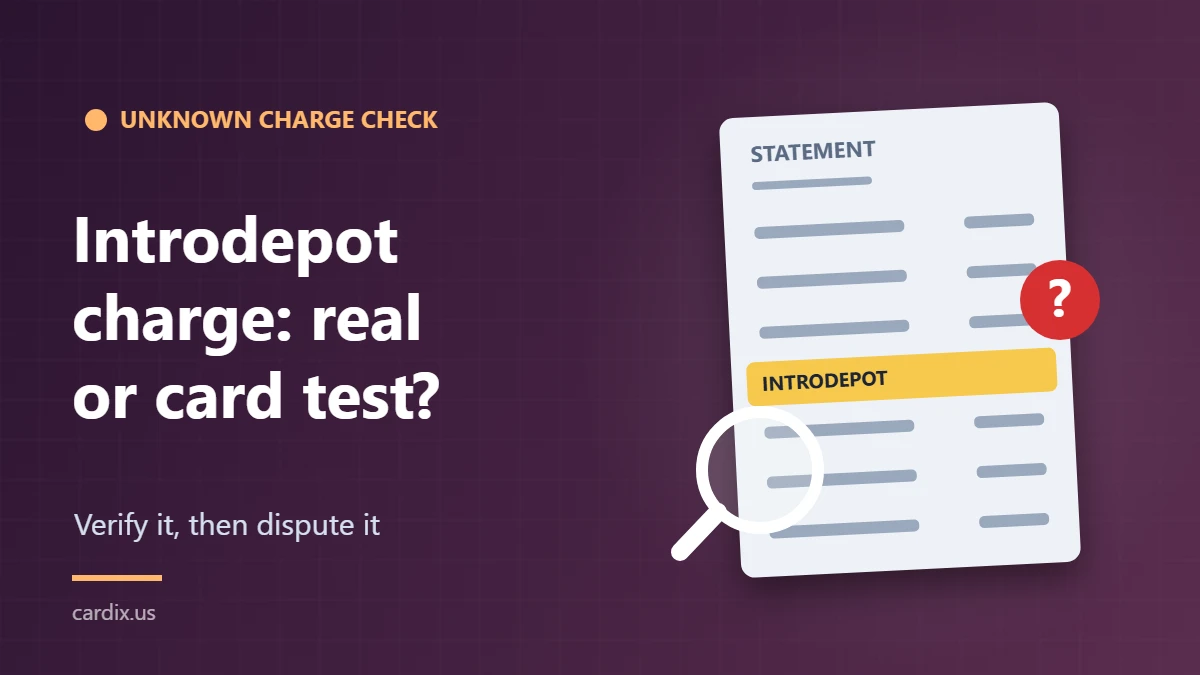
If you found an Introdepot charge on your credit card, start with one question: did you, or anyone using your card, recently buy real estate listing photos, a virtual tour, or another marketing service, possibly from a Georgia-based provider? If not, and the amount is small or odd, treat it as unauthorized and call your card issuer today. Here’s what public records show about the name, and how to settle the charge either way.
What Is the Introdepot Charge?
There’s no official billing page or help article where any company says “we bill as INTRODEPOT.” So no one can name the merchant behind every charge with certainty. What can be checked is the history of the name.
- The domain is old and still active. Public domain registry data shows introdepot.com was first registered in May 2000 through GoDaddy and was renewed through 2027.
- It started as a video directory. An archived 2003 copy of the IntroDepot site describes a service that made videos of “people and products,” with provider categories such as real estate agent, landscaper, and dentist, and a “© IntroDepot, Inc.” footer.
- Today it points to a real estate photographer. When we checked in November 2026, introdepot.com redirected to the “Order Package” page of Eddy James, a real estate photography and virtual tour business serving the Atlanta metro area. An August 2026 archived copy of that page lists listing-marketing packages from $109 to $199 based on square footage.
That redirect is a real clue, but it isn’t proof that a given charge came from that business. We found no official statement linking the “INTRODEPOT” descriptor to Eddy James or any other merchant. Some websites say IntroDepot, Inc. is registered in Acworth, Georgia, but they cite no source, and we couldn’t confirm it in a state registry.
Two Likely Explanations
1. A real purchase billed under an older business name
Small businesses sometimes bill under an older corporate name instead of the brand you remember. If you’re a real estate agent, a landlord, or a homeowner who recently listed a property near Atlanta, and you ordered photos, a walkthrough video, or a virtual tour, the charge may be that order. Check whether the amount matches an invoice.
2. Card testing by someone with your card number
If you’ve never bought anything like that, the more likely story is fraud. Criminals with stolen card numbers often run tiny charges, sometimes under $1, to see whether a card works before trying larger purchases. Reports collected on charge-lookup websites describe Introdepot charges in that cents-level range, though those reports can’t be independently verified. A charge of less than a dollar from a name you’ve never heard of fits the card-testing pattern far better than a real photo package does.
How to Check the Charge in 10 Minutes
- Look at the full transaction details. In your card app, open the charge itself. Many issuers show a longer merchant name and location that the statement line cuts off.
- Search your email. Try “Introdepot,” “Intro Depot,” “Eddy James,” “virtual tour,” and “listing photos.” A legitimate order nearly always leaves a receipt or invoice.
- Ask anyone else on the account. Authorized users, a business partner, or an office manager may have booked a photo shoot with the card.
- Compare the amount. A charge in the low hundreds that matches a property’s size could be a real order. A charge of a few cents or a few dollars almost certainly isn’t a photography package.
- Check for repeats. Scan the last two or three statements for other small charges from names you don’t recognize.
If you find a match, contact the business through its own website and ask for an itemized receipt.
What to Do If You Didn’t Authorize It
- Call your issuer right away. Use the number on the back of your card or the app, say the charge is unauthorized, and ask them to close the card number and send a new one. A dispute alone won’t stop a thief who has the number.
- Know your liability limit. Under federal law, your liability for unauthorized credit card charges is capped at $50, and the CFPB explains that if someone uses your stolen account number without taking the card, you generally owe nothing.
- Put it in writing if needed. If the issuer doesn’t fix it on the phone, the FTC explains how to send a written billing dispute to the billing-inquiries address so it arrives within 60 days of the first statement showing the charge. The issuer must acknowledge it within 30 days and resolve it within 90 days.
- Secure the source. Think about where you recently entered your card, such as a new online store or a “free trial,” and change that account’s password.
- Escalate if it’s bigger than one card. If other accounts were opened or used, report it at IdentityTheft.gov to get a step-by-step recovery plan.
What to Do If It Was a Real Order
If the charge matches photos or a virtual tour you ordered, it’s not fraud, and filing a fraud claim could cause problems with the vendor. If the amount is wrong or the work wasn’t delivered, contact the business first. If it won’t fix the problem, you can still file a billing-error dispute within the same 60-day window.
Tiny charges like this behave much like a $1 charge on a credit card, which can be either a harmless authorization hold or a card test. For the bigger picture, see our guide to common credit card fraud types. Seeing other unknown names? Our guide to verifying unknown charges helps.
Quick Answers
Is Introdepot a scam?
The name traces back to a real business and domain, so the name itself isn’t proof of a scam. But a small charge you can’t match to any order should be treated as unauthorized until proven otherwise.
Will my bank refund a 50-cent charge?
Yes. Issuers handle unauthorized charges of any size. Replacing the card matters more, so the number can’t be used again.
How do I avoid the next one?
Turn on real-time alerts for every transaction, including amounts under $1, and use virtual card numbers for unfamiliar sites.
This article is general information, not financial or legal advice. Your card agreement and your issuer’s policies control how your dispute is handled.

Emma Rose is a U.S.-based personal finance writer and a regular contributor at Cardix.us. She focuses on topics like credit cards, credit scores, and everyday money management. Emma’s writing makes complex financial concepts simple and practical, helping readers make smarter credit and spending decisions with confidence.